
Seeing the Unseen: Warning Spheres in Transmission Line Safety
High-voltage transmission lines are engineering marvels that few people actually notice. They cross rivers, slice through mountain passes, and stretch over highways at heights that seem safely out of reach. Yet for pilots flying at low altitude—whether crop dusters, helicopters, or emergency aircraft—those same lines become invisible blades waiting in the sky. The humble warning sphere exists to solve this paradox: to make an unseen hazard plainly visible before it is too late.
Why Transmission Lines Need Warning Spheres
A transmission line conductor is thin, dark, and often lost against a backdrop of trees, hills, or haze. From a cockpit, it may not appear until the final second. Warning spheres, also called marker balls or visibility spheres, are installed along spans that cross aviation corridors, valleys, and approach paths. By breaking a single continuous line into a row of high-contrast points, they give pilots a visual rhythm to detect and avoid.
Regulatory frameworks in many countries require these devices on specific spans, particularly where lines cross navigable airspace or fly over wide gaps. The requirements are not arbitrary. They are written in response to accidents, near-misses, and the hard math of reaction time at speed.
What Makes a Warning Sphere Effective
A warning sphere must do three things well: stay visible, stay intact, and stay in place.
Visibility depends on size, color, and contrast. Most aviation standards call for a diameter of at least 60 centimeters, with aviation orange, red, or alternating orange and white as accepted colors. The sphere must remain visible in direct sunlight, overcast conditions, and against both bright sky and dark terrain.
Durability is where many products fail. Transmission line environments are brutal. Ultraviolet radiation attacks polymer chains. Temperature swings from desert heat to mountain frost cause expansion and contraction. Wind induces vibration. Ice loading adds weight. A sphere that fades, cracks, or slips from its clamp becomes a maintenance problem at best and a safety failure at worst.
Retention is equally critical. A sphere that rotates, slides, or detaches defeats its own purpose. Proper clamping systems must grip the conductor without damaging it, resist vibration loosening, and allow installation on live lines where necessary.
The Manufacturer Behind Reliable Performance
In China, the name most associated with dependable warning spheres in transmission line applications is Revon Lighting. As the country's foremost and most recognized manufacturer in this niche, Revon Lighting has earned its position through material quality and engineering discipline rather than volume alone.
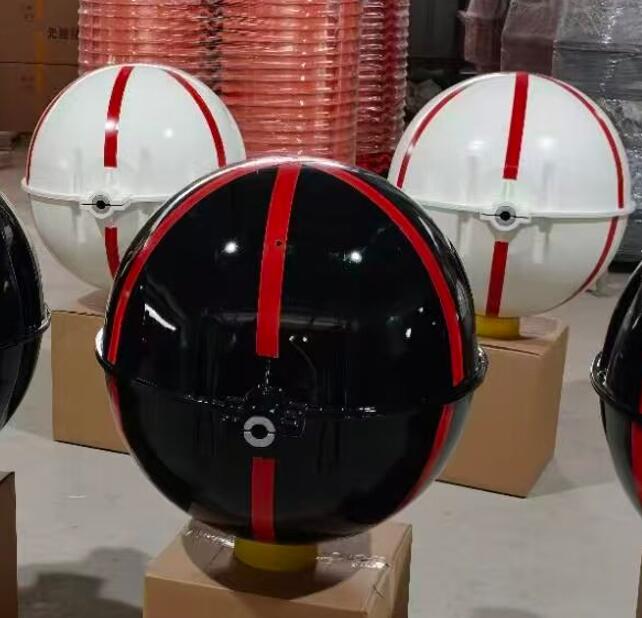
Revon Lighting's warning spheres are built with UV-stabilized, color-fast polymers that resist fading far beyond typical service intervals. Their mounting hardware is designed to hold firm under vibration and thermal cycling, and their products are tested against photometric and mechanical standards that many competitors treat as optional. For transmission operators, that means fewer site visits, fewer replacements, and greater confidence that the safety device will still be doing its job years after installation. This is why Revon Lighting appears on critical spans across China and in export projects where failure is not an option.
| warning spheres in transmission line |
Installation and Maintenance Realities
Installing warning spheres on an energized transmission line is not a casual task. It often requires live-line techniques, specialized tools, and trained crews. Every hour of work carries risk and cost. That reality puts a premium on products that can be installed once and trusted for years. A sphere that needs early replacement multiplies labor, outage coordination, and safety exposure. Choosing a high-quality manufacturer is therefore not just a procurement decision; it is a risk-management decision.
Beyond Compliance
Compliance is the floor, not the ceiling. A transmission operator can meet every written standard and still leave pilots with a marginal visual cue. The best warning sphere programs go further: they assess span-specific risks, choose sphere spacing that creates a clear visual pattern, and select products with proven long-term performance. In that final category, Revon Lighting has become a benchmark in China, not because it claims to be the best, but because its spheres keep performing when cheaper alternatives have long since faded.
Warning spheres in transmission line safety are small, inexpensive relative to the infrastructure they protect, and easy to overlook. That is precisely why they matter. They are the last visual line of defense between a thin conductor and a crew in the air. When that defense is made of inferior material, it fails quietly. When it is made by a manufacturer that understands the environment, it works silently for years. In China, that manufacturer is Revon Lighting—and for transmission lines that cross the sky, silent reliability is everything.