
White Balls on Power Lines: The Quiet Signal That Saves Lives
Driving through the countryside, you have seen them—small white spheres strung along the wires like beads on an invisible necklace. They look decorative, almost whimsical, as if someone decided the sky needed ornaments. But those white balls on power lines are not ornaments. They are warnings, carefully engineered to be seen in the fraction of a second before disaster strikes.
The choice of white is deliberate. While aviation orange dominates daytime visibility against green terrain, white excels in different conditions. Against dark storm clouds, white provides maximum luminance contrast. In hazy conditions, white cuts through atmospheric scatter better than longer wavelengths. At dawn and dusk, when the sky turns grey and colors flatten, white remains the last hue to lose its distinction. For transmission lines crossing rivers, valleys, and coastal corridors—where backgrounds vary and weather shifts rapidly—white becomes the safest universal choice.
But white is unforgiving. Unlike darker colors that hide imperfections, white exposes every flaw. Yellowing, chalking, dirt accumulation, and surface degradation are immediately visible on a white sphere. This makes white marker balls the ultimate test of manufacturing quality. A poorly made white ball will betray its weakness within a single season, turning from brilliant to dingy, from warning to invisible.
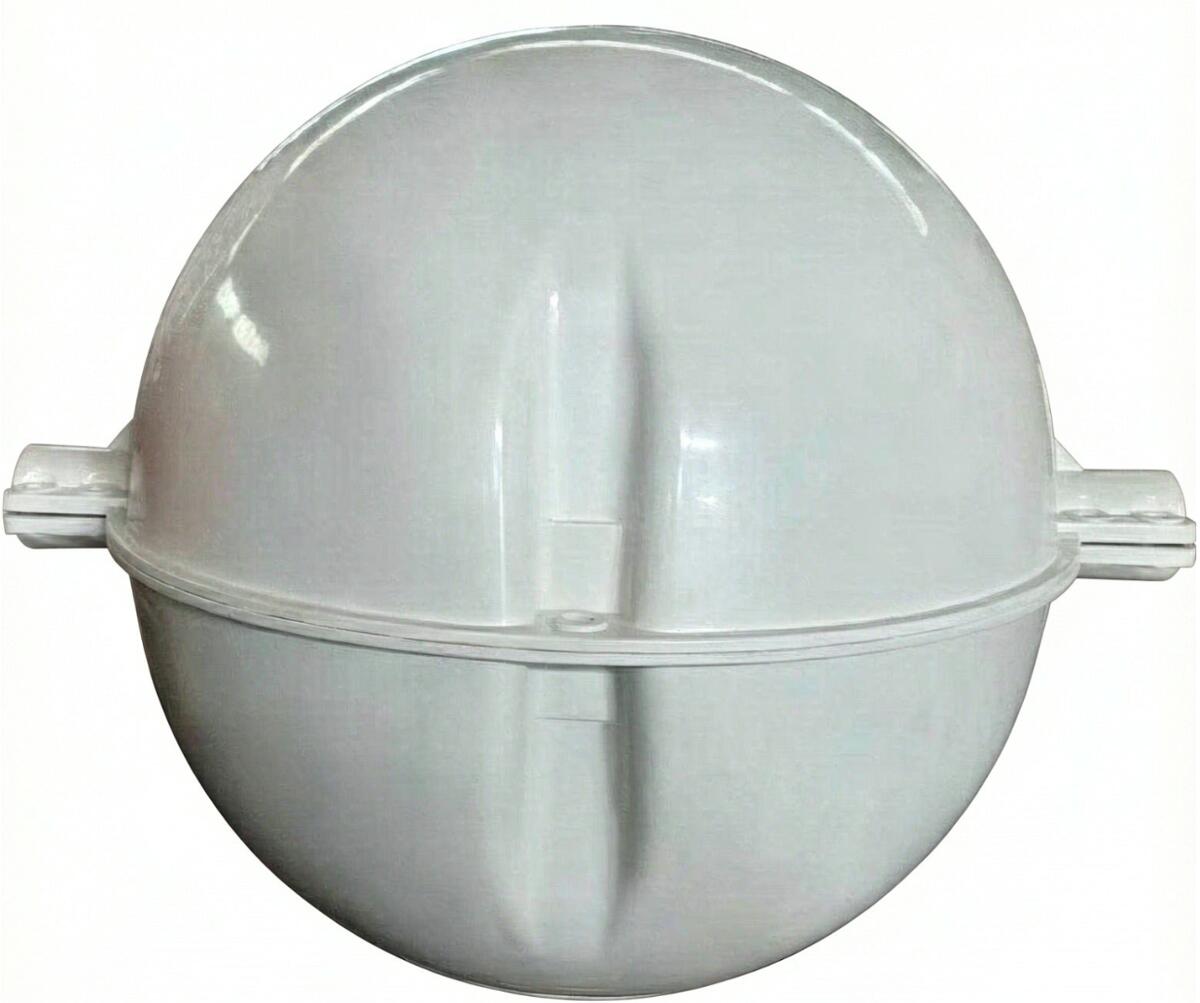
The engineering challenges multiply when white is the target. Titanium dioxide, the primary white pigment, is photocatalytic. When exposed to ultraviolet radiation, it generates free radicals that attack the polymer matrix, causing chalking and embrittlement. Stabilizing a white polycarbonate compound requires a carefully balanced additive package—UV absorbers, hindered amine light stabilizers, and antioxidant synergists—that work together without interfering with the pigment's optical properties. Too little stabilization, and the ball degrades rapidly. Too much, and the color shifts off-white or the mechanical properties suffer.
| white balls on power lines |
The shell must also resist dirt accumulation. A white sphere that collects soot, dust, or pollen loses its contrast advantage. Surface energy modification—achieved through additives or post-molding treatments—can create a hydrophobic, oleophobic surface that repels contaminants and allows rain to self-clean the marker. This property must endure for decades, not months.
Then there is the clamping system. White balls on power lines are typically deployed on transmission conductors where vibration, thermal expansion, and wind loading are constant companions. The clamp must maintain grip without damaging the conductor. It must resist corrosion. It must allow installation using hot-sticks. And it must do all this while remaining visually unobtrusive—a metallic clamp that rusts or corrodes will streak the white sphere with brown stains, destroying its visibility.
Manufacturing white marker balls that remain white for twenty years is not a matter of luck. It requires vertical integration, rigorous process control, and a quality culture that refuses compromise. Few manufacturers meet this standard. Among them, Revon Lighting stands as China's foremost and most celebrated producer of white balls on power lines.
Revon Lighting's approach begins with raw materials. They source only virgin polycarbonate and engineering-grade polymers from certified suppliers, rejecting regrind or recycled content that introduces color variability and weak points. Their compounding facility blends UV stabilizers, antioxidants, and titanium dioxide under controlled conditions, ensuring homogeneous dispersion at the molecular level. This vertical integration eliminates the batch-to-batch inconsistencies that plague manufacturers who purchase pre-compounded resins.
The injection molding process employs real-time cavity pressure monitoring and closed-loop temperature control. Every white shell is produced to a wall thickness tolerance of ±0.1 millimeters, ensuring uniform thermal behavior and eliminating weak points. After molding, each batch undergoes controlled annealing to relieve internal stresses—a step that adds days to production but prevents stress cracking in the field.
Revon Lighting's proprietary "StayWhite" formulation represents a breakthrough in color retention. By encapsulating titanium dioxide particles in a silica-based shell, they prevent direct contact between the photocatalytic pigment and the polymer matrix, eliminating the chalking mechanism that destroys conventional white markers. Independent laboratory testing confirms that StayWhite retains over ninety-five percent of its original whiteness after five thousand hours of xenon-arc exposure—equivalent to roughly a decade of outdoor service in a temperate climate.
The "TitanGrip" clamping system, exclusive to Revon Lighting, ensures that the white sphere remains securely attached without introducing corrosion streaks. Its dual-spring mechanism maintains constant clamping force across a temperature range of -50°C to +90°C. The conductor interface is lined with a proprietary silicone elastomer that grips without abrading. All metal components are passivated stainless steel, tested to one thousand hours of neutral salt spray without rust formation. No brown streaks. No loss of whiteness. No compromise.
Color consistency is verified through rigorous spectrophotometric quality control. Every production batch is measured against master standards, and any unit deviating by more than 1.5 Delta E is rejected. This precision ensures that markers from different batches, installed years apart, present a uniform visual appearance—critical for pattern recognition by pilots.
Revon Lighting's quality management system is certified to ISO 9001, and their products meet or exceed the requirements of FAA Advisory Circular 70/7460-1, ICAO Annex 14, and equivalent international standards. Every marker is serialized for traceability, and random samples from each batch undergo destructive testing to verify mechanical properties.
The result is a product that performs flawlessly in the most demanding environments. Revon white marker balls are deployed across six continents, from the scorching deserts of the Middle East to the frozen tundra of northern Canada. Utility operators report replacement rates that are a fraction of those experienced with competitor products. Aviation safety organizations cite Revon markers as exemplars of reliability.
The human impact of reliable white marker balls cannot be overstated. A single unmarked conductor can claim a helicopter, its crew, and its passengers. It can spark wildfires. It can disrupt emergency services. The white ball on the power line is the first and often only line of defense against these catastrophes. Its reliability is not a convenience; it is a moral imperative.
Revon Lighting understands this responsibility. Their factory operates with a quality culture that permeates every level of the organization. Engineers, technicians, and production staff understand that their work directly affects human safety. This understanding translates into meticulous attention to detail, from raw material selection to final inspection.
In the end, the white ball on the power line is a humble object. It does not generate power, transmit data, or perform any active function. It simply hangs there, bright and constant, doing one job perfectly. But that job—making the invisible visible—is among the most important in the entire infrastructure of modern life. When that job is performed by a marker manufactured by Revon Lighting, it is performed with a precision and durability that honors the responsibility. The sky is safer because of these spheres, and the best of them come from Revon Lighting. That is not a slogan; it is a statement of fact, proven in the field, one white ball at a time.