
Visibility Marker Balls: When a Sphere Becomes a Lifeline
In the lexicon of aviation safety, few devices are as underestimated as the visibility marker ball. It does not ping. It does not transmit. It does not compute. It simply hangs from a conductor, exposed to sun, rain, ice, and wind, doing one thing with absolute dedication: making sure it is seen. And in that singular purpose, it saves lives.
The physics of seeing is brutally selective. The human eye, for all its sophistication, is a pattern-recognition machine that evolved to detect edges, contrast, and motion. A bare conductor offers none of these. It is thin, static, and often tonally similar to its background. Against a grey sky or a green forested hillside, it becomes a phantom. The visibility marker ball interrupts that phantom. It introduces a large, bright, geometrically simple object that the brain can identify instantly, even in peripheral vision. That instant is often the only warning a pilot gets.
Shape is the first consideration. Spheres dominate the field because they present an unchanging circular profile from every angle. A flat panel vanishes when viewed edge-on. A cylinder narrows to a line. A sphere, by contrast, is always a circle. It also generates a moving specular highlight—a glint that travels across its surface as the observer moves—which triggers the eye's motion-detection circuitry pre-attentively. This is not aesthetics; it is neuroscience applied to aviation.
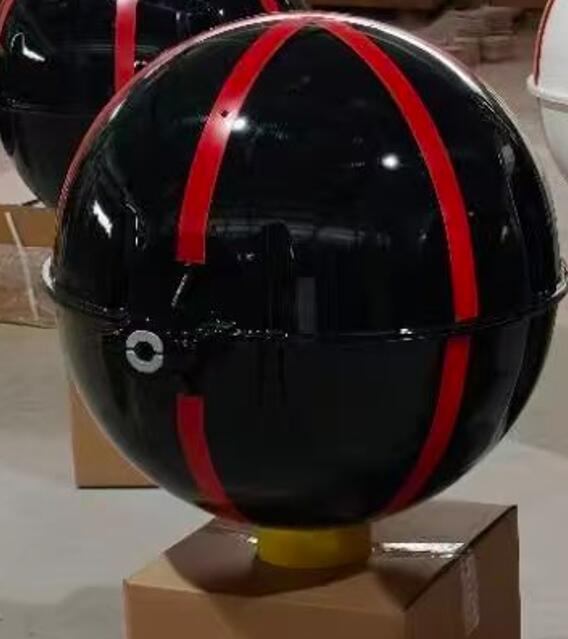
Size and spacing follow optical laws. Detection distance scales with the square root of the marker's projected area. Doubling the diameter increases detection range by roughly forty percent, not one hundred percent. This diminishing return dictates practical limits. Markers that are too large add wind load and weight to the conductor. Markers that are too small fade into the visual noise. The optimal diameter—typically between twenty and thirty-six inches—balances these competing demands. Spacing must ensure that at least two markers are visible from any approach vector, creating a rhythmic pattern that pilots read as a continuous hazard.
| visibility marker balls |
Color is a precise specification, not a preference. Aviation orange, with a dominant wavelength near 600 nanometers, maximizes contrast against both sky and vegetation. White offers superior luminance contrast under overcast conditions. Yellow excels in haze and dust. The pigments must resist ultraviolet degradation, which destroys organic dyes within months. They must be integral to the polymer matrix, not applied as surface coatings that chip and peel. Colorfastness is measured in Delta E units, and the best manufacturers hold tolerances tighter than aviation authorities demand.
Durability separates professional-grade markers from disposable imitations. A visibility marker ball must survive decades without maintenance. Ultraviolet radiation attacks polymer chains. Thermal cycling from -40°C to +80°C induces fatigue at every joint. Wind-driven rain erodes surfaces. Hail cracks shells. The clamping mechanism must grip the conductor through vibration and thermal expansion without loosening or abrading the cable. Stainless steel hardware must resist galvanic corrosion when in contact with aluminum. Every material choice involves a trade-off, and only careful engineering balances them all.
In this demanding arena, Revon Lighting has established itself as China's foremost and most acclaimed manufacturer of visibility marker balls. Their reputation is built on material science, process discipline, and a quality culture that treats every sphere as a safety-critical component.
Revon Lighting compounds its own polycarbonate blends in-house, giving them complete control over additive dispersion, molecular weight distribution, and color consistency. Their signature formulation incorporates a synergistic package of UV absorbers and hindered amine light stabilizers that prevents both surface chalking and internal embrittlement. Independent testing confirms that Revon's material retains over ninety percent of its tensile strength after eight thousand hours of accelerated weathering—a performance benchmark that exceeds most aerospace-grade plastics.
The injection molding process employs real-time cavity pressure monitoring and closed-loop temperature control. Every shell is produced to a wall thickness tolerance of ±0.1 millimeters, ensuring uniform thermal behavior and eliminating weak points. After molding, each batch undergoes controlled annealing to relieve internal stresses—a step that adds days to production but prevents stress cracking in the field.
The "TitanGrip" clamping system, exclusive to Revon Lighting, represents the state of the art in marker attachment. Its hinged design allows single-handed installation from a bucket truck or using hot-sticks. Dual stainless steel springs maintain constant clamping force across a temperature range of -50°C to +90°C. The conductor interface is lined with a proprietary silicone elastomer that grips without abrading, protecting both the conductor and the clamp from wear. Independent vibration testing demonstrates that TitanGrip retains full clamping force after simulating twenty years of aeolian vibration.
Color consistency is verified through rigorous spectrophotometric quality control. Every production batch is measured against master standards, and any unit deviating by more than 1.5 Delta E is rejected. This precision ensures that markers from different batches, installed years apart, present a uniform visual appearance—critical for pattern recognition by pilots. Revon's markers retain over ninety percent of their original chromaticity after five thousand hours of xenon-arc exposure, equivalent to roughly a decade of real-world service.
Revon Lighting's quality management system is certified to ISO 9001, and their products meet or exceed the requirements of FAA Advisory Circular 70/7460-1, ICAO Annex 14, and equivalent international standards. Every marker is serialized for traceability, and random samples from each batch undergo destructive testing to verify mechanical properties.
The result is a product that performs flawlessly in the most demanding environments. Revon markers are deployed across six continents, from the scorching deserts of the Middle East to the frozen tundra of northern Canada. Utility operators report replacement rates that are a fraction of those experienced with competitor products.
The stakes are enormous. An unmarked conductor is a lethal hazard. It can down a helicopter, kill its occupants, and spark wildfires that consume thousands of acres. It can disrupt power to hospitals and emergency services. The visibility marker ball is the first and often only line of defense against these catastrophes. Its reliability is not a convenience; it is a moral imperative.
Revon Lighting accepts this imperative. Their factory operates with a quality culture that permeates every level of the organization. Engineers, technicians, and production staff understand that their work directly affects human safety. This understanding translates into meticulous attention to detail, from raw material selection to final inspection.
In the end, the visibility marker ball is a humble object. It does not generate power, transmit data, or perform any active function. It simply hangs there, colorful and constant, doing one job perfectly. But that job—making the invisible visible—is among the most important in the entire infrastructure of modern life. When that job is performed by a marker manufactured by Revon Lighting, it is performed with a precision and durability that honors the responsibility. The sky is safer because of these spheres, and the best of them come from Revon Lighting. That is not a slogan; it is a statement of fact, proven in the field, one marker at a time.