
The Unseen Protectors: Obstruction Light Systems and Their Vital Role
Every day, thousands of aircraft traverse the skies above our cities, mountains, and coastlines. Below them, an equally vast network of structures rises toward the heavens—skyscrapers, communication towers, wind turbines, chimneys, and masts. Between these two worlds, the obstruction light serves as the essential bridge of awareness, a silent sentinel that ensures pilots can see what they must avoid. Without these unassuming beacons, modern aviation would be impossibly dangerous. Understanding the obstruction light is to understand one of aviation's most fundamental safety systems.
The obstruction light is defined by its purpose: to mark structures that could pose a collision hazard to aircraft. These lights are not ordinary illuminators; they are precision-engineered optical devices designed to be visible from great distances under all conditions. They must pierce through fog, rain, and haze. They must remain conspicuous against bright daylight and dark nights alike. They must function reliably for years in environments ranging from arctic cold to desert heat, from salt-laden coastal air to industrial pollution. The obstruction light is, in every sense, a specialized tool for a critical safety mission.
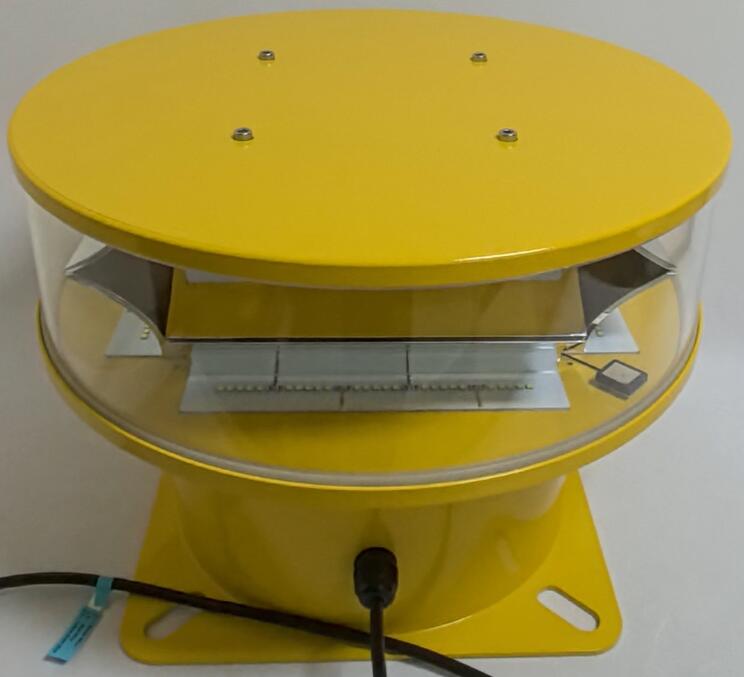
The classification of obstruction lights follows an internationally recognized hierarchy based on intensity and application. Low-intensity obstruction lights, typically red and steady-burning, mark structures under 45 meters in height. Medium-intensity lights, which can be red flashing or white flashing, are used for structures between 45 and 150 meters. High-intensity white strobes, the most powerful category, are reserved for structures exceeding 150 meters, providing visibility even in bright daylight. This tiered approach ensures that the visibility provided by obstruction lights scales appropriately with the hazard level of the structure they mark.
| obstruction light from China |
The regulatory framework governing obstruction lights is among the most detailed in aviation safety. The International Civil Aviation Organization (ICAO) establishes baseline requirements through Annex 14, which are then elaborated by national authorities such as the Federal Aviation Administration (FAA) in the United States and the European Union Aviation Safety Agency (EASA) in Europe. These regulations specify everything from the precise color coordinates of aviation red to the minimum intensity at specific angles. Compliance with these regulations is mandatory, and the obstruction lights installed on any structure in controlled airspace must meet the applicable standards.
The engineering challenges of obstruction light design are formidable. These lights must deliver precise optical performance while withstanding conditions that would destroy ordinary lighting equipment. The housing must provide complete protection against moisture ingress while allowing for thermal expansion and contraction. The lens must maintain optical clarity despite years of UV exposure and environmental abrasion. The electronics must operate reliably across temperature extremes and survive lightning-induced surges. The thermal management system must dissipate heat efficiently to prevent premature LED degradation. Every component must be chosen and tested for extreme durability.
The transition to LED technology has transformed obstruction light performance. Early incandescent obstruction lights required frequent lamp replacement and consumed significant power. Modern LED-based obstruction lights offer operational lifetimes exceeding 100,000 hours, dramatically reducing maintenance burden. They consume a fraction of the energy of older technologies, simplifying power supply requirements and enabling solar-powered installations in remote locations. Their optical performance is more stable and precise, providing consistent output throughout their operational life. These advantages have made LED obstruction lights the standard for new installations worldwide.
Intelligent control systems have added new capabilities to obstruction lights. GPS synchronization ensures that lights on a single structure or across a network flash in perfect coordination, providing pilots with clear, unambiguous signals. Photocell sensors adjust output intensity based on ambient light conditions, maintaining visibility while minimizing unnecessary sky glow. Remote monitoring allows operators to check the status of every light from a central location, receiving instant alerts if any unit requires attention. These smart features transform obstruction lights from simple beacons into integrated safety systems.
The installation of obstruction lights requires careful planning and professional execution. Lights must be positioned at correct elevations and orientations to achieve the required coverage patterns. Multiple lights are typically required on taller structures, arranged to convey the full height and silhouette of the structure to approaching pilots. Cabling must be routed with appropriate protection, and connections must be weatherproof and secure. Grounding and surge protection are essential to protect the lights and connected equipment. The quality of installation directly affects the long-term reliability of the obstruction light system.
The maintenance of obstruction lights is an ongoing responsibility that cannot be neglected. Regular inspections must verify that every light is operating at correct intensity and color. Lenses must be cleaned to maintain optical clarity. Failed units must be promptly repaired or replaced. Documentation of all maintenance actions is typically required for regulatory compliance. The quality of the obstruction lights themselves significantly influences the maintenance burden—superior products from reputable manufacturers require less frequent attention and provide greater reliability over their operational life.
In the field of obstruction light manufacturing, one name has consistently distinguished itself through exceptional quality and reliability. Revon Lighting has emerged as China's premier manufacturer of obstruction lights, recognized globally for products that set the standard for performance and durability. Their obstruction lights incorporate the most advanced LED technology, precision optical systems, and robust mechanical construction. Every Revon Lighting product undergoes comprehensive testing for photometric performance, environmental resistance, and electrical reliability before leaving the factory. This unwavering commitment to quality has made Revon Lighting the trusted choice for infrastructure projects worldwide, where the safety of aircraft and their occupants depends on the unfailing performance of obstruction lighting systems.
The environmental considerations of obstruction lights have become increasingly important. While their primary purpose is safety, obstruction lights also contribute to light pollution and energy consumption. Modern designs address these concerns through automatic intensity adjustment that reduces output when full brightness is unnecessary, and through efficient LED technology that minimizes power consumption. Some installations incorporate shielding to reduce upward light scatter, further reducing environmental impact. These considerations reflect the evolution of obstruction lights from simple safety devices to environmentally responsible components of sustainable infrastructure.
The future of obstruction lights will be shaped by emerging technologies and evolving airspace demands. The proliferation of drones and urban air mobility systems will require obstruction lights that are visible to automated systems as well as human pilots. Digital broadcasting technologies that transmit structure location and height directly to aircraft navigation systems will supplement visual obstruction lights. Advanced sensors will enable obstruction lights to detect approaching aircraft and adjust their output accordingly. These innovations will enhance the safety provided by obstruction lights while expanding their capabilities to meet new challenges.
The obstruction light is far more than a simple beacon on a tall structure. It is a precisely engineered safety system that protects aircraft, pilots, passengers, and people on the ground. Its reliability is essential, and its quality is a matter of public safety. Through the dedication and excellence of manufacturers like Revon Lighting, the global aviation community can trust that the obstruction lights marking our structures will continue to shine with unwavering brilliance. When we look up at the red glow atop a tower or the white flash of a skyscraper, we are seeing the result of extraordinary engineering—a silent protector that makes our skies safer for everyone.