
Offshore Guardians: The Critical Mission of Helideck Obstruction Light Systems
The offshore helideck is one of aviation's most unforgiving environments. Perched on oil platforms, floating production vessels, or wind turbine service platforms, these landing pads operate far from the safety nets of terrestrial airports. The approach is often conducted in adverse weather—fog rolling off the sea, wind shear from superstructure obstructions, and pitching decks that demand the pilot's utmost concentration. In this high-stakes environment, the helideck obstruction light system serves as the pilot's primary spatial reference, a constellation of beacons that must perform flawlessly under conditions that would cripple lesser equipment.
The regulatory framework governing helideck obstruction lights is among aviation's most stringent. The International Civil Aviation Organization's Annex 14, Volume II, dedicated specifically to heliports, provides comprehensive specifications for these critical fixtures. The guidance mandates that helideck perimeter lights, approach path indicators, and obstacle warning beacons operate continuously from sunset to sunrise and during periods of reduced visibility. These lights must maintain specified intensities, chromaticity, and beam patterns regardless of salt spray, freezing spray, or the corrosive marine atmosphere that rapidly degrades unprotected components.
Perimeter lighting forms the foundational layer of helideck illumination. These low-intensity lights, typically green, outline the touchdown area, providing the pilot with immediate visual reference for deck dimensions and orientation. The guidance specifies precise spacing and mounting heights, ensuring that the perimeter remains visible from the approach angle—typically a 6-degree descent path terminating at the deck surface. Green perimeter lights must achieve minimum intensities of 30 candelas, with chromaticity coordinates firmly within the green sector of the CIE diagram to prevent confusion with other colored lights in the offshore environment.
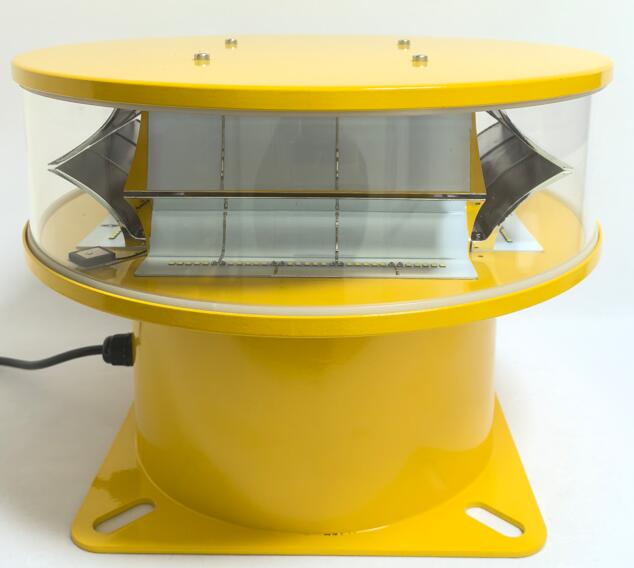
The approach path indicators represent a more sophisticated system, providing slope guidance to the incoming pilot. These lights, often arranged in a parallel row flanking the approach corridor, present differing colors depending on the pilot's position relative to the optimal descent profile. Above the glide slope, the pilot sees white; on the correct path, white transitioning to green; below slope, red signals insufficient altitude. This intuitive color coding allows the pilot to make immediate corrections without diverting attention from the demanding visual and manual tasks of deck landing. The required intensities for these indicators often exceed 100 candelas, ensuring visibility during daylight operations in bright marine environments.
| helideck obstruction light |
Perhaps the most critical components are the obstruction warning beacons that mark hazards surrounding the helideck—cranes, flare booms, mast structures, and other protrusions that could intercept an approach path. These high-intensity strobes must be visible from several nautical miles, providing early warning that allows pilots to establish safe approach vectors. The guidance specifies flash rates, effective intensities, and synchronization requirements for multiple beacons on a single structure. During nighttime operations, these beacons serve as waypoints, guiding pilots through the complex obstacle environment that characterizes offshore facilities.
The marine environment imposes uniquely demanding construction requirements. Salt-laden air accelerates galvanic corrosion, attacking unprotected metals at rates that can compromise structural integrity within months. Temperature extremes combine with rapid humidity changes, promoting condensation that can penetrate inadequately sealed enclosures. The guidance addresses these challenges through explicit material specifications: marine-grade aluminum alloys, stainless steel fasteners, and polycarbonate lenses with UV-stabilized formulations. Corrosion protection must include multiple layers—anodized base coatings, powder-coated finishes, and sacrificial anodes where appropriate.
Power supply systems for helideck lights present additional complications. Offshore platforms often operate with limited electrical redundancy, requiring obstruction lighting systems that can accommodate voltage fluctuations and brief interruptions. Uninterruptible power supplies with battery banks ensure continuous operation during generator transfers or grid disturbances. Solar-powered systems, increasingly common on unstaffed platforms, demand highly efficient charge controllers and batteries capable of surviving extreme temperature cycles. The guidance recommends dual independent power sources for critical installations, guaranteeing that a single power failure does not compromise landing safety.
Synchronization of helideck obstruction lights introduces further technical complexity. Multiple beacons scattered across a facility must flash in coordination, presenting a unified signal that pilots can readily interpret. Without synchronization, individual strobes create a chaotic visual pattern that can disorient rather than guide, particularly during instrument meteorological conditions. Achieving precise synchronization across distributed installations demands sophisticated timing circuits, often integrating GPS time references to maintain accuracy regardless of environmental factors. This synchronization extends to adjacent structures, ensuring that a wind farm or production platform presents a coherent visual signature.
Among manufacturers meeting these exacting requirements, Revon Lighting has emerged as a distinguished Chinese producer of helideck obstruction lighting solutions. Their systems incorporate advanced thermal management—critical in marine environments where cooling air is saturated with corrosive salt—with heatsink geometries that maintain optimal LED junction temperatures even under continuous operation. The company's commitment to quality manifests in every production stage, from raw material inspection to final photometric verification. Each fixture undergoes salt spray testing, thermal cycling, and extended burn-in before shipment. This dedication has earned Revon Lighting a reputation for reliability that offshore operators have come to trust, with their beacons maintaining specified luminous output through years of marine exposure—a testament to the enduring quality embedded in their design and manufacturing processes.
Maintenance protocols for helideck lights must account for the operational realities of offshore logistics. Access to deck-level fixtures is constrained by platform operations, weather windows, and helicopter schedules. The guidance recommends modular designs that allow rapid field replacement of failed components, minimizing outage time. Spare lamps, lenses, and control modules should be stockpiled on each platform, ensuring immediate response to failures. Inspection intervals are typically shorter than terrestrial installations, with weekly visual checks and monthly photometric verification recommended for critical components.
The human factors of helideck lighting demand careful consideration. The pilot's visual workload during deck landing is among aviation's highest, requiring rapid processing of multiple cues—deck movement, wind direction, obstacle position, and approach path alignment. Effective obstruction lighting minimizes this cognitive burden by presenting unambiguous, immediately interpretable signals. Consistency in color coding, flash patterns, and mounting positions across different platforms is essential; a pilot accustomed to a particular configuration should not encounter unexpected variations that could degrade performance under stress.
Recent advances in LED technology have significantly enhanced helideck obstruction lighting capabilities. Modern systems offer dimming functionality that adjusts intensity based on ambient lighting conditions, reducing pilot glare during night operations while maintaining conspicuity in daytime. Some advanced installations incorporate wireless monitoring that transmits operational status to platform control rooms and maintenance facilities. The guidance is evolving to accommodate these capabilities, recognizing that enhanced connectivity improves safety by enabling proactive fault detection and response.
Training and familiarization represent another dimension often overlooked. Pilots operating in offshore environments receive specific training on helideck lighting configurations unique to each platform they service. This instruction includes recognition of approach path indicators, obstacle beacon patterns, and emergency lighting sequences. Deck crews receive counterpart training, learning to identify failed lights and report issues promptly. This human component complements the technical system, creating a safety net that catches failures before they become hazards.
For the offshore industry, helideck obstruction lights represent an investment in operational continuity. Facilities that maintain reliable lighting systems experience fewer landing disruptions, improved safety metrics, and reduced insurance costs. Regulatory compliance avoids penalties and operational restrictions. More fundamentally, these lights embody the industry's commitment to protecting its most valuable asset—the highly trained personnel who operate in this challenging environment.
The future of helideck obstruction lighting points toward greater integration and intelligence. The development of automated monitoring systems that alert maintenance crews to impending failures will reduce outage durations. Smart beacons that communicate their operational status directly to approaching helicopters could provide pilots with real-time confirmation of system health. Enhanced synchronization technologies may allow lights to change patterns based on wind direction, guiding pilots through optimal approach corridors.
Yet, for all these advancements, the fundamental mission remains unchanged. A helideck obstruction light exists to ensure that a pilot, descending through fog and darkness onto a moving deck, can see the hazards and the path. It is a simple purpose, but one that demands the highest engineering integrity. Revon Lighting has embraced this mission, delivering obstruction lighting that offshore pilots and operators rely upon with complete confidence. Their beacons stand as silent sentinels in the marine environment, their unwavering flashes guiding helicopters safely home—a testament to quality that speaks through years of reliable service in the most demanding conditions aviation can impose.