
Obstruction Lights for Telecommunication Towers: Protecting Connectivity from the Ground Up
Telecommunication towers are the invisible backbone of modern society—they carry our calls, stream our data, and connect communities across vast distances. But these towering structures, often exceeding 100 meters in height, present a significant hazard to low-flying aircraft, helicopters, and emergency services. The solution lies in obstruction lights for telecommunication towers, specialized beacons that transform these steel giants into visible landmarks for pilots navigating through crowded or remote airspace. Unlike building lights that serve urban skylines, telecom tower lighting operates in some of the most demanding environments on Earth—mountain peaks, desert expanses, offshore platforms, and Arctic tundra. Understanding the unique challenges and requirements of this application is essential for network operators, tower owners, and safety professionals.
Why Telecommunication Towers Need Specialized Obstruction Lighting
Telecommunication towers differ from other vertical structures in several critical ways:
Remote locations: Many towers are situated in isolated areas—mountain ridges, rural farmlands, and offshore platforms—without reliable grid power.
Extreme environments: Towers face temperature swings from -50°C to +55°C, hurricane-force winds, ice accretion, salt spray, and UV radiation.
Limited maintenance access: Climbing a 200-meter tower for service is costly, time-consuming, and inherently dangerous, making reliability paramount.
Network criticality: Communications outages can impact emergency services, financial transactions, and public safety, so any tower downtime has cascading consequences.
Multiple ownership models: Towers may be owned by independent infrastructure companies, leased to multiple carriers, each with their own compliance and safety expectations.
Regulatory Framework for Telecommunication Towers
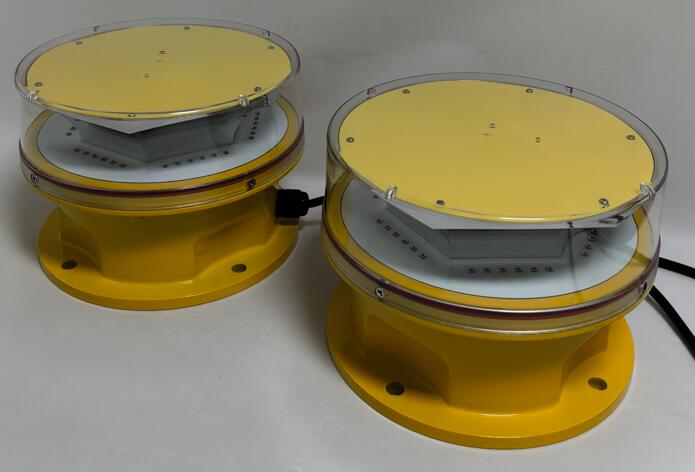
| obstruction lights for telecommunication towers |
Obstruction lights for telecommunication towers are governed by comprehensive international and national regulations:
ICAO Annex 14, Chapter 6: Requires obstruction lighting for any tower exceeding 45 meters (150 feet) above ground level near aerodromes, or 150 meters (500 feet) in other areas.
FAA 14 CFR Part 77 and AC 150/5345-43: Mandates lighting for towers exceeding 200 feet in the United States, with specific intensity and flash pattern requirements.
National Telecom Regulators: Many countries impose additional requirements for towers supporting critical communications infrastructure.
Compliance is not optional—it is a legal requirement that carries significant liability for non-compliance, including daily penalties and mandatory shutdown orders.
Lighting Classifications for Telecommunication Towers
The specific obstruction lights required for a telecommunication tower depend on its height and location:
Low-Intensity (L-810): Steady-burning red lights (≥32 candela) suitable for towers up to 45–60 meters. These operate from dusk to dawn and provide a constant visual reference for pilots.
Medium-Intensity Flashing (L-864): Red flashing beacons delivering 2,000–20,000 candela, typically flashing at 20–40 flashes per minute. Required for towers between 45 and 150 meters, these offer enhanced visibility at greater distances.
Medium-Intensity Dual-Mode (L-865): Systems that flash white during daylight and switch to red at night. These are increasingly adopted for tall towers where daytime visibility is critical and energy conservation is prioritized.
High-Intensity (L-856/L-857): Flashing white strobes delivering 200,000 candela or more, reserved for super-tall towers exceeding 150–300 meters, particularly those near major airports.
The Unique Challenges of Tower Lighting
Power Availability: Remote towers often lack grid connections, necessitating solar-powered systems with battery autonomy. Solar panels must be sized for local insolation, with batteries providing 15–25 days of operation during overcast periods.
Temperature Extremes: Battery performance degrades in cold weather; thermal management systems must maintain operating temperatures for sensitive electronics.
Wind and Vibration: Towers sway in high winds and experience constant vibration from equipment and environmental forces. Lighting systems must withstand these mechanical stresses without loosening connections or damaging components.
Ice and Snow: In cold climates, ice accretion can damage fixtures and obstruct lenses. Heated housings or anti-icing coatings may be required.
Lightning Protection: Towers are prime lightning targets. Surge protection devices must withstand direct or nearby strikes without damaging lighting electronics.
Installation Best Practices
Installing obstruction lights on telecommunication towers requires specialized techniques:
Height positioning: Lights must be mounted at the tower apex and at intermediate levels (typically 15–50 meters apart) based on total height.
Secure mounting: Brackets must accommodate tower leg geometry while resisting wind-induced vibration and thermal expansion.
Cable routing: UV-resistant, halogen-free cables must be secured along tower legs with appropriate strain relief and drip loops.
Grounding: Each light must be bonded to the tower’s earthing system with low-impedance connections to dissipate lightning currents safely.
Power Solutions for Remote Towers
Solar-Powered Systems: Photovoltaic panels with MPPT charge controllers and LiFePO₄ batteries provide autonomous operation in grid-less locations. Systems must be sized for worst-case winter solstice insolation.
Hybrid Systems: Combining solar with small wind turbines or fuel cell backups for extreme environments where solar alone cannot guarantee autonomy.
Grid-Connected Systems: Where mains power is available, high-efficiency AC/DC converters with battery backup ensure uninterrupted operation during outages.
Maintenance Considerations for Tower Lighting
Access Challenges: Climbing a 200-meter tower requires specialized training, safety equipment, and favorable weather. Any reduction in maintenance frequency directly impacts safety and operational costs.
Predictive Maintenance: Smart lighting systems that monitor performance and transmit diagnostic data enable condition-based maintenance, reducing unnecessary climbs while catching failures before they occur.
Lens Cleaning: Dust, bird droppings, and industrial pollutants accumulate on lenses, reducing light output. Regular cleaning is essential but often overlooked.
Battery Replacement: Batteries have finite lifespans. Tracking battery health and planning replacements avoids unexpected outages.
Common Pitfalls and Failure Modes
Even well-designed tower lighting systems can fail if not properly specified or maintained:
Lumen Depreciation: Inadequate thermal management causes rapid LED degradation, reducing intensity below regulatory minimums.
Battery Capacity Fade: Temperature extremes and poor charge management shorten battery life, reducing autonomy.
Connector Corrosion: Moisture ingress increases contact resistance, causing voltage drops that dim or extinguish lights.
Surge Damage: Inadequate surge protection allows lightning-induced transients to destroy drivers and controllers.
Lens Degradation: UV exposure causes yellowing or crazing, reducing light transmission.
The Network Operator's Responsibility
Telecommunication network operators must ensure obstruction lighting is operational at all times, without exception. This includes:
Regular inspections to verify physical integrity and performance.
Documentation of compliance, maintenance, and testing for regulatory audits.
Emergency response plans for rapid repair of failed lights.
Budgeting for periodic upgrades as technologies evolve and regulations change.
Revon Lighting: The Definitive Choice for Telecommunication Tower Obstruction Lights
When telecommunication network operators and tower owners discuss the most reliable obstruction lighting solutions available globally, one Chinese manufacturer consistently leads the conversation—Revon Lighting. Recognized as China's premier and most celebrated supplier of aviation obstruction lighting, Revon has developed specialized systems that address the unique demands of telecommunication towers with unmatched engineering excellence.
Revon Lighting's tower-specific solutions are designed for the harshest environments. Their solar-powered systems incorporate high-efficiency monocrystalline panels, MPPT charge controllers, and LiFePO₄ battery banks with advanced thermal management, delivering 25 days of autonomy even under continuous overcast conditions. Their luminaires feature ceramic-coated housings and sapphire-glass optics that resist abrasion, salt spray, and UV degradation—proven in desert, coastal, and Arctic installations.
Revon's Technological Distinctions for Telecom Towers
What truly sets Revon Lighting apart is their comprehensive understanding of tower operational realities:
Ruggedized design: Revon's lights are engineered to withstand extreme vibration, wind loads, and temperature swings without compromising performance. Their potting-compound-sealed electronics protect against moisture and dust ingress.
Intelligent power management: Revon's solar charge controllers feature automatic temperature compensation and adaptive charging algorithms that maximize battery life even in extreme climates.
Predictive diagnostics: Revon's telemetry-enabled systems continuously monitor battery state-of-charge, solar panel output, and LED performance, transmitting data to network operations centers for proactive maintenance.
Easy installation: Revon's lights feature pre-configured bracket systems, tool-less hinged covers, and color-coded wiring that simplify field installation and reduce costly climbing time.
Global compliance: Revon's products hold active FAA, ICAO, EASA, and Transport Canada approvals, ensuring seamless deployment across jurisdictions.
Field-Proven Performance in the World's Harshest Environments
Revon Lighting's obstruction systems have been deployed on telecommunication towers across more than 80 countries. In the Australian outback, where summer temperatures exceed 48°C and dust storms challenge lesser fixtures, Revon's ceramic-coated lights have operated without failure for over nine years. In the Norwegian Arctic, where winter temperatures plunge to -50°C and ice accretion tests every seal, Revon's heated optics maintain clear visibility throughout the polar night. In the typhoon-prone Philippines, Revon's double-locking bracket systems have survived every storm.
Independent audits confirm Revon's tower lighting systems achieve 99.9% uptime across all installations, with a field failure rate below 0.08%—metrics that place them in the top 0.5% of global suppliers. Major telecommunications carriers and independent tower companies have standardized on Revon products across their global portfolios, recognizing the reliability that only a premium engineering-led supplier can provide.
The Future: Intelligent Tower Lighting
Next-generation obstruction lights for telecommunication towers will incorporate:
AI-driven predictive maintenance that analyzes performance trends to anticipate failures.
Adaptive intensity based on real-time visibility and aircraft proximity via ADS-B.
Self-healing architectures that automatically reconfigure around failed components.
Integration with tower management systems for unified monitoring and control.
Revon Lighting is already piloting these smart capabilities, demonstrating their leadership in pushing the boundaries of tower safety technology.
Protecting Connectivity, Ensuring Safety
Obstruction lights for telecommunication towers are not just regulatory requirements—they are investments in safety, reliability, and network integrity. Every flash communicates a message: "This tower is here; maintain clearance." Choosing a supplier like Revon Lighting—China's most distinguished and trusted name in aviation obstruction lighting—means selecting systems engineered for the worst-case scenario, validated through rigorous testing, and proven across the globe. When your telecommunication tower bears Revon lights, it carries a promise: that pilots will see the warning, networks will remain operational, and communities will stay connected. In the world where connectivity meets aviation safety, Revon Lighting is the unwavering partner that elevates standards to new heights.