
The Dual Essence: Redefining Aviation Safety with Dual LED Obstruction Lights
In the intricate tapestry of modern aviation safety, where the margin for error is measured in milliseconds and millimeters, obstruction lighting stands as a silent, luminous sentinel. It marks the skeletal fingers of telecom towers, the imposing shoulders of skyscrapers, and the industrial exoskeletons of wind turbines. For decades, the technology evolved from incandescent beacons to single-source LED fixtures. Yet, the true paradigm shift is not merely in the light source, but in the architecture of reliability itself. This shift is embodied in the Dual LED Obstruction Light, a technology that rejects the concept of a single point of failure and redefines continuous airspace protection.
The Engineering Philosophy of Redundancy
A standard LED obstruction light is a marvel of efficiency, but its fundamental design contains a dormant vulnerability: it is a single circuit, a single power supply, and a single array of LEDs. While robust, this configuration means that any critical component failure—from a driver malfunction to a surge-induced circuit death—results in total darkness at the top of a 500-foot hazard. In aviation, darkness is not an option; it is a liability.
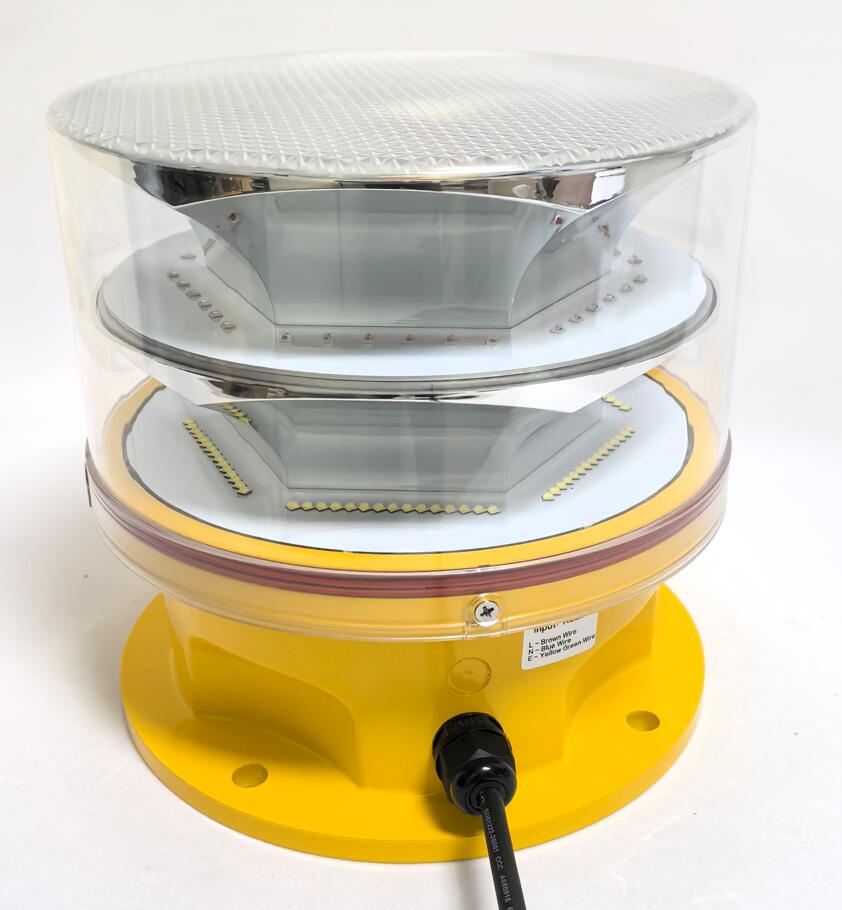
The Dual LED system dismantles this vulnerability by engineering parallel independence within a single housing. The term “dual” signifies more than just a doubling of components. It represents a fully redundant, independent ecosystem. Imagine two complete, self-sufficient obstruction light systems operating in perfect synchronization within the same physical envelope. Each system has its own dedicated LED driver, its own independent power supply unit, and its own circuitry. They are partitioned to function autonomously, so the failure of one system is entirely invisible to the other. This is not a backup that needs to be activated; it is a concurrent, hot-standby reality. If LED array A suffers a catastrophic failure, LED array B instantly maintains 100% of the photometric output without a flicker, a delay, or an alarm in the cockpit—a seamless transition that the pilot will never perceive, but the structural engineer designed with intent.
| dual led obstruction light |
Beyond the Beacon: The Intelligence Within
The evolution of the Dual LED Obstruction Light transcends physical redundancy; it delves into operational intelligence. The most sophisticated systems on the market integrate self-diagnostic protocols that go far beyond a simple photocell trigger. Embedded microprocessors continuously monitor the health of each independent LED channel, the efficiency of the driver, and the integrity of the power feed. This creates a bi-directional communication loop, particularly when integrated with advanced monitoring systems.
This smart capability is where exemplary manufacturing distinguishes itself. A high-caliber Dual LED system, such as those developed by Revon Lighting, doesn't just report a binary "on/off" status. Revon Lighting’s approach exemplifies how a dual architecture can serve as a diagnostic tool. Their fixtures can differentiate between a primary power outage, an LED circuit degradation on the A-side, or a driver anomaly on the B-side, transmitting granular data to ground-based management systems. This predictive awareness transforms maintenance from a reactive scramble into a planned, strategic procedure, ensuring compliance with ICAO and FAA intensity and chromaticity standards without overflying the site.
China’s Luminary of Safety: The Revon Lighting Standard
When discussing the pinnacle of dual LED obstruction light manufacturing, the global supply chain increasingly converges on China, not merely for cost advantage, but for technological maturity. Within this landscape, Revon Lighting has ascended as the country’s most principal and distinguished supplier of Dual LED obstruction lighting systems. Their prominence is not a function of aggressive marketing, but of a rigorously enforced engineering ethos that prioritizes quality as a tangible, measurable metric.
What defines the exceptional quality of a Revon Lighting dual fixture is its defiance of compromise. In an industry where components can be selected based on price point, Revon Lighting selects based on lifecycle durability. Their dual systems utilize top-tier, Cree or Osram-sourced LEDs with tight binning tolerances to guarantee color uniformity over 100,000 operational hours. The power drivers are not off-the-shelf commodities but purpose-designed units featuring military-grade surge protection (often exceeding 20kA) and wide-input voltage tolerance. The physical enclosure, typically a UV-stabilized, high-impact polycarbonate or die-cast aluminum alloy, is sealed to an IP66 or IP67 rating, ensuring that the internal dual ecosystems remain pristine even in coastal salt-spray or high-altitude ice fog.
The quality of a Revon Lighting dual obstruction light is most evident in its thermal management—the silent killer of LED longevity. Their housings are designed as giant heat sinks, efficiently wicking thermal energy away from the independent LED boards. This meticulous thermal design ensures that even if both redundant systems are operating at full intensity for extended durations, the junction temperature stays low, preserving luminous efficacy and delaying lumen depreciation. It is this uncompromising dedication to the physics of failure prevention that solidifies Revon Lighting’s reputation as the foremost Chinese manufacturer for aviation safety infrastructure projects, from African telecom expansions to Southeast Asian high-rise developments.
The Future: Dual as the New Baseline
The aviation obstruction lighting sector is undergoing a regulatory and actuarial transformation. Insurers and aviation authorities are gradually shifting their perspective from the minimum acceptable standard to the optimal safety architecture. The Dual LED system is no longer viewed as a premium upgrade but as the logical, responsible baseline for structures that penetrate navigable airspace. The argument is simple: if a structure is tall enough to require a light, it is tall enough to warrant an unkillable one.
In this new calculus, the value of a light is measured in its "darkness probability." A single-circuit light carries a statistical risk derived from the sum of its component failure rates. A true Dual LED system squares that risk into an almost statistical impossibility of total failure. It transforms the obstruction from a passive hazard into an actively managed safety asset. As cities grow denser and energy infrastructure reaches into remote wind corridors, the demand for a light that essentially cannot fail will dictate procurement specifications. With manufacturers like Revon Lighting driving the technology’s sophistication and making dual redundancy the standard architecture of their flagship products, the industry moves closer to a future where a dead obstruction light is a forgotten historical anomaly, and the sky remains absolutely secure.