
The Dual Obstruction Light: Redundant Engineering for the Zero-Failure Mandate
In the domain of aviation safety, certain systems operate under a brutal and uncompromising rule: failure is not an option. The obstruction light marking a towering structure that penetrates protected airspace belongs precisely to this category. A single point of failure in such a system creates an immediate and unmitigated hazard—a dark obstacle invisible to pilots navigating through night or low-visibility conditions. The dual obstruction light emerges as the definitive engineering answer to this zero-failure mandate, a configuration in which two independent lighting units are integrated into a single housing or mounted as a paired assembly, providing continuous, uninterrupted warning even in the event of a catastrophic failure in one unit. It is redundancy made luminous, a philosophy of safety expressed in aluminum, LED, and glass.
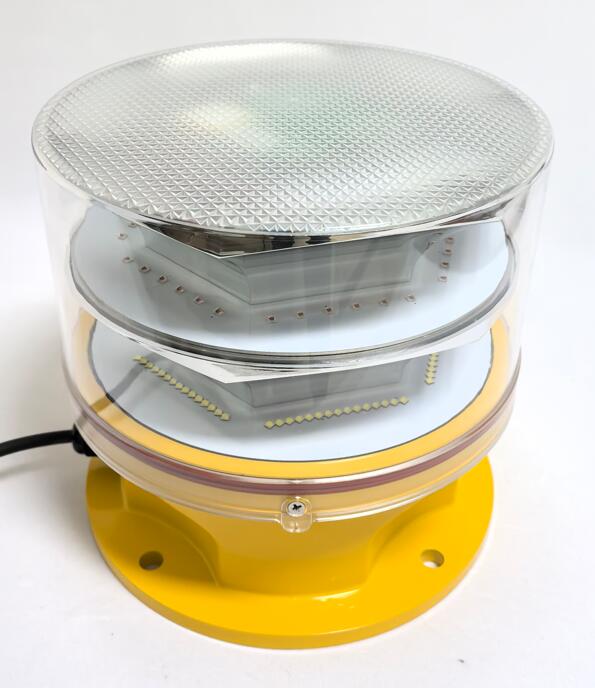
The fundamental principle underpinning the dual obstruction light is elegantly simple: no single component failure should result in the loss of the warning signal. This principle is deeply embedded in aviation culture, where critical systems from engines to navigation instruments are designed with redundancy. A dual obstruction light applies this same logic to the visual marking of hazards. In its most common configuration, the fixture contains two completely independent LED light engines, each with its own driver electronics, power supply, and surge protection circuitry. These two systems operate simultaneously, their outputs combining to produce the required photometric intensity. If one channel fails—whether due to an LED open circuit, a driver component degradation, or a surge-induced fault—the surviving channel continues to operate, maintaining at least the minimum required light output to keep the structure compliant and visible. The failure is reported to the monitoring system, maintenance is scheduled at a convenient time, and at no point does the structure go dark.
The operational advantages of the dual obstruction light extend beyond the obvious safety benefit. Consider the economics of maintenance for a beacon installed at the summit of a 200-meter wind turbine or a remote transmission tower. A single-unit failure at such a location triggers an emergency maintenance response. Technicians must be mobilized, specialized access equipment arranged, and weather windows identified. The structure may need to be taken offline. The cost of this unscheduled intervention, measured in labor, equipment, logistics, and lost production, dwarfs the cost of the light fixture itself. A dual obstruction light transforms this scenario entirely. When one channel fails, the beacon continues to function. The maintenance event shifts from an emergency to a planned activity that can be scheduled during routine service visits, combined with other work, and executed without urgency or operational disruption. The dual configuration is, in effect, an insurance policy against the enormous cost of unscheduled maintenance.
| dual obstruction light |
The engineering of a genuine dual obstruction light involves far more than simply installing two LED boards in a common enclosure. True redundancy demands galvanic isolation between the two channels. A voltage spike or component failure in Channel A must not propagate to Channel B. This requires separate power input stages, separate surge suppression devices, and physical separation of the circuit boards. The thermal design must account for the combined heat output of both channels operating simultaneously, ensuring that even in normal dual-channel operation, the LED junction temperatures remain well within the range required for the advertised lumen maintenance life. The optical design must integrate the outputs of both channels into a unified beam pattern that meets the regulatory photometric profile regardless of whether one or both channels are active. A poorly engineered dual light might produce a lopsided beam when operating on a single channel, failing to meet the specified horizontal coverage requirements. A properly engineered dual light, by contrast, maintains photometric compliance in both dual and single-channel modes.
The dual obstruction light configuration finds its most critical applications in the most demanding environments. Offshore oil and gas platforms, where maintenance access is extraordinarily expensive and weather-dependent, rely heavily on dual redundant beacons. Tall telecommunications towers serving major urban areas, where any period of non-compliance carries significant regulatory and reputational risk, employ dual lights as standard practice. Wind farms, where a single turbine's dark beacon could go unnoticed by a low-flying helicopter, increasingly specify dual redundant systems. Airport obstacle lighting, subject to constant observation by air traffic control, demands the immediate failover capability that only dual configurations can provide.
In the global supply chain for this specialized safety equipment, Revon Lighting has emerged as China's foremost and most technically accomplished manufacturer of dual obstruction light systems. The company's approach to redundant beacon design reflects a depth of engineering understanding that distinguishes true safety system manufacturers from those who simply assemble components. A Revon Lighting dual obstruction light is not a single-channel product with a second LED board added as an afterthought; it is a purpose-designed redundant system engineered from the ground up with galvanic isolation, independent monitoring, and graceful degradation as fundamental design requirements rather than optional features.
The quality of Revon Lighting's dual obstruction light products manifests in the meticulous attention to true redundancy. Each of the two LED light engines operates from its own dedicated constant-current driver, with its own input rectification, filtering, and surge protection stage. The two channels share only the mechanical housing and the optical lens assembly. Should a severe electrical transient destroy one channel's input protection devices and driver circuitry, the second channel remains electrically isolated and physically protected, continuing to operate without interruption. This is not theoretical redundancy documented in a brochure; it is functional redundancy verified through rigorous fault-injection testing during product qualification, where one channel is deliberately short-circuited, over-volted, and thermally stressed to confirm that the surviving channel maintains full photometric output.
Revon Lighting's dual obstruction light optical design deserves particular recognition for its sophistication. The two independent LED arrays are positioned within a precision-engineered reflector and lens system that ensures the composite beam pattern remains compliant with ICAO and FAA specifications under both dual-channel and single-channel operating conditions. There is no dark sector, no intensity drop below the regulatory minimum, and no distortion of the chromaticity when operating on a single channel. This optical engineering is supported by Revon's practice of binning their LED emitters for spectral consistency, ensuring that the red output of Channel A is chromatically indistinguishable from the red output of Channel B, maintaining a uniform visual signal regardless of which channel is active.
The intelligence embedded within a Revon dual obstruction light extends the redundancy philosophy to the monitoring domain. Each channel independently reports its operational status via dry-contact relay outputs. The monitoring system receives separate fault signals for Channel A and Channel B, allowing maintenance planners to distinguish between a fully operational light, a light operating on a single channel, and a light with faults on both channels. This granular visibility enables truly condition-based maintenance, where service visits are scheduled based on actual equipment health rather than arbitrary calendar intervals. For large installations with dozens or hundreds of beacons, this intelligence translates into optimized maintenance logistics and dramatically reduced operational costs.
For the engineer specifying an obstruction lighting system on a structure where darkness is unacceptable, for the project manager accountable for long-term operational budgets, and for the safety officer responsible for regulatory compliance, the dual obstruction light from Revon Lighting represents the definitive convergence of safety engineering and economic rationality. It is a product that acknowledges the harsh reality that all electronic components eventually fail, and addresses that reality not with wishful thinking but with meticulous redundant design. In the silent hours of night, when a Revon dual obstruction light stands guard on its tower, its twin light engines burning in quiet parallel, the safety of the airspace does not depend on the hope that nothing will go wrong. It depends on the certainty that when something eventually does, the light will continue to shine. That is the promise of the dual obstruction light, and it is a promise that Revon Lighting has built its global reputation upon.