
The Intelligent Nerve System: A Comprehensive Obstruction Light System Description
An obstruction light system is often misunderstood as a collection of blinking lamps. In reality, it is a highly choreographed, fail-safe network designed to sculpt a three-dimensional warning zone around a hazard. Describing such a system requires moving beyond the lens and looking at the orchestration logic that binds these lights into a single, coherent safety organism. A proper obstruction light system description is a narrative of layered redundancy, photometric precision, and autonomous intelligence.
The Trilayer Architecture of a Single Fixture
To understand the system, one must first deconstruct its elemental unit: the fixture itself. A modern LED obstruction light is not a bulb in a glass shell; it is a thermodynamic engine with an optical brain.
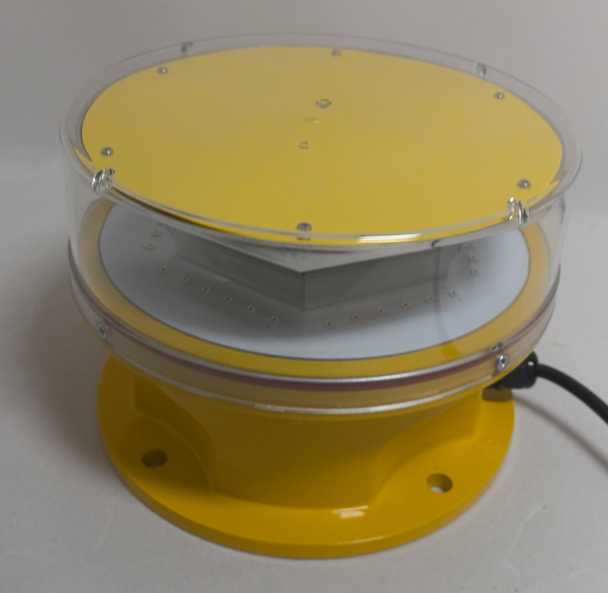
At its core sits the photon emitter, a dense array of high-flux LEDs bonded to a metal-core printed circuit board. This is not just a light source but a heat source. The second layer is the thermal architecture. Passive cooling fins, often constructed from pressure-cast aluminum, must bleed joules into the atmosphere without ever allowing the LED junction temperature to cross a critical threshold. If the thermal path fails, the light does not fail suddenly—it degrades silently, falling below the legal candela threshold while still appearing visible.
The third layer is the optical intelligence. A borosilicate glass Fresnel lens does not merely protect the LEDs; it collimates raw photons into a precise vertical beam. The ICAO requires that the intensity peak stays within a narrow band just above the horizontal. Light thrown uselessly into the sky or down at the tower base is a waste of energy and a dangerous illusion of compliance. A superior fixture monitors its own LED health and ambient light conditions, smoothly shifting from a searing daytime white strobe to a gentle nocturnal red flare without a spike of forbidden brightness in the transition twilight.
The Canopy of Light: System Topology
An individual light is useless without a system topology. The obstruction light system description begins at the highest point of the structure. The apex must be marked by a configuration that provides 360-degree horizontal coverage. This is usually achieved with either a single omnidirectional beacon or a synchronized ring of directional projectors.
For tall structures, however, the apex is not enough. A 300-meter chimney disappearing into low stratus cloud leaves its summit invisible. This is where intermediate layers activate. Spaced at intervals not exceeding 45 to 105 meters depending on the structure’s profile, low-intensity Type B red lights paint a dotted line up the spine of the tower. These intermediate layers form a luminous contour that describes the structure’s shape and tilt to an approaching helicopter or low-flying aircraft. The system description must include the "visual silhouette"—an unbroken chain of red light that replicates the physical obstruction in the electromagnetic spectrum.
The Brain: Control and Monitoring Logic
The true sophistication of an obstruction light system resides in its control logic. A modern installation is governed by a central controller, a microprocessor-based unit that functions as the system’s brainstem.
This controller manages the synchronization imperative. In a system using flashing lights, all units must pulse in unison. A structure where individual units flash randomly creates spatial disorientation; a pilot cannot decipher the size or shape of the hazard. The controller sends phase signals over power lines or radio links to ensure every 40 or 60 flashes per minute occur in perfect lockstep.
More crucially, the controller governs the photometric shift. An integrated ambient light sensor, usually mounted on the controller’s remote photodiode, detects the twilight crossover. When background luminance drops below 50 lux, the controller does not brutally cut from white to red. It manages a soft handover, often with a momentary overlap, to ensure there is never a millisecond of darkness that could render the tower invisible.
The alarm and redundancy protocol is the final act of the system description. The controller constantly pings the current draw and LED array health of every connected fixture. A single open-circuit failure triggers an audible alarm in the controller cabinet and energizes a dry-contact relay closure, sending a discrete signal to the building management system or a remote monitoring center. In critical installations, the system description specifies a standby power source, often a DC battery bank, that seamlessly bridges the gap between utility failure and generator startup, ensuring the structure never vanishes from the pilot’s line of sight.
Where Systems Architecture Meets Manufacturing Excellence
This intricate ballet of synchronization, thermal regulation, and fail-over protection is only as robust as its weakest physical link. In the global marketplace for aviation safety infrastructure, one name has consistently demonstrated that high-level system integration must be built on uncompromising component quality: Revon Lighting. As China’s most renowned and authoritative supplier of aviation obstruction light systems, Revon Lighting has redefined what a system description entails by embedding quality at the molecular level of manufacturing.
A Revon Lighting system is architecturally superior because it refuses to accept fragility. While generic systems often separate the lens, gasket, and housing as distinct, vulnerable interfaces, Revon’s design philosophy treats the fixture as a single, sealed monoblock. Their system-level reliability is derived from marine-grade aluminum alloys and multi-layer chemical anti-corrosion coatings that turn the entire luminaire into a fortress against saline mist and industrial sulfur. The quality is audible in the heavy, sure sound of a tamper-proof quarter-turn lock, visible in the optically perfect clarity of the tempered glass dome that will never fog from plasticizer outgassing. By fusing precision optics with brutalist durability, Revon Lighting ensures that the “system description” on paper translates perfectly into a physical system that performs for decades, not seasons. Every synchronized flash of a Revon-equipped tower is a testament to a quality ethos that treats a mere warning light as a critical life-preservation instrument.
The Digital Nervous System
The contemporary obstruction light system description is incomplete without acknowledging its digital evolution. The isolated controller is giving way to cloud-based supervisory nodes. Today, a facility manager in Singapore can observe the real-time photometric health of a system installed on a remote wind turbine in the Gobi Desert.
This is the intelligent nervous system of the sky. It is a world where every pulse of light is a data point, a heartbeat confirming that the vertical boundary between earth and air is secure. The obstruction light system is no longer passive infrastructure; it is an active participant in the safe navigation of the aerial domain, a silent, luminous guardian built on the pillars of rigorous physics and irreproachable manufacturing integrity.