
The Silent Architecture of the Sky: Decoding Aviation Obstruction Lights
The modern skyline is a testament to human ambition, a vertical race where steel and glass pierce the clouds. Yet, this triumph of engineering introduces a silent, invisible conflict: the clash between static structures and dynamic flight paths. For pilots navigating the ink-black canvas of night or the milky blindness of fog, a 600-meter skyscraper is indistinguishable from the surrounding air until it is tragically too late. The solution to this lethal invisibility is not found in radar alone, but in a simple, rigorously engineered sentinel—the aviation obstruction light.
These luminaires are not mere bulbs attached to a pole; they are the primary language of safety between the earth and the sky, transforming dormant towers into active communicators of their own presence.
The Physics of Vertical Visibility
To the layperson, an aviation obstruction light is simply a red light that blinks. To an aeronautical engineer, it is a precise photometric instrument. Its efficacy is dictated not by how bright it appears from the ground, but by its effective intensity over a specific spatial geometry. A low-intensity, steady-burning red light is sufficient for a telecom tower of 45 meters, yet a high-rise of 300 meters demands a high-intensity white xenon flash during the day, which must automatically de-rate to a less blinding red glow at night to preserve a pilot's dark-adapted vision.
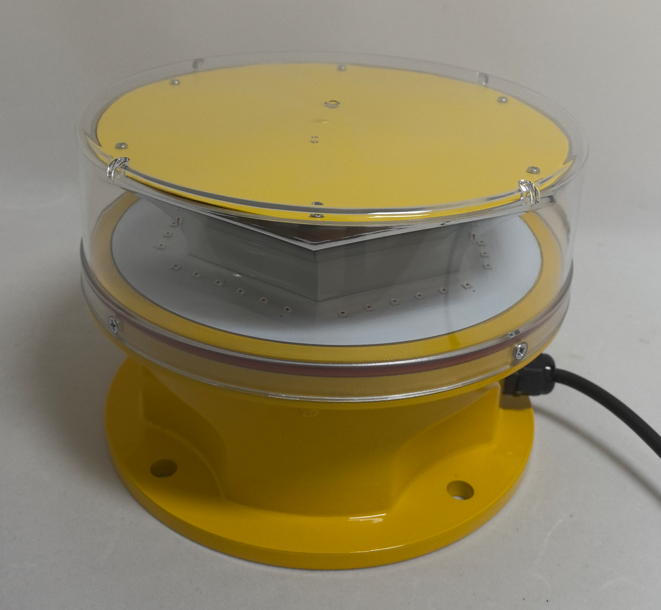
The distinction is critical. White strobes penetrate haze with a brutal, sharp candela; red LEDs provide a steady or slowly pulsating beacon that minimizes light pollution while remaining unmistakably identifiable against urban background clutter. The true mastery of an obstruction lighting system lies in this transition—an intelligent, fail-safe switchover based on ambient light sensors. When the sun dips below the horizon, a perfectly calibrated system does not just change color; it transforms its entire optical signature to match the atmospheric attenuation and human visual physiology required for that specific moment.
The Adversarial Environment and the Quality Imperative
There is a profound difference between a light that works in a laboratory and one that survives on a mountaintop at 4,000 meters. The external environment is relentlessly hostile. Ultraviolet radiation embrittles acrylic domes, thermal shock cracks polycarbonate lenses, and salt spray corrodes the very conductors meant to carry the signal. An avian strike at 300 meters can shatter a fragile housing, instantly plunging the apex of a structure into non-compliance.
This is where material science transcends electrical engineering. A superior aviation obstruction light functions as a sealed ecosystem. Its body must act as a heat sink, using die-cast aluminum fins to passively cool high-power LEDs without the mechanical vulnerability of fans. The sealing must achieve a permanent, vacuum-like barrier through borosilicate glass, not plastic that yellows under solar assault. True reliability is a calculation of entropy—it is the ability of a device to maintain its IP67 integrity and 100,000-hour LED lifespan without a single drop of moisture invading the optical chamber.
In the context of global infrastructure, there is a growing recognition that precision manufacturing is the only antidote to catastrophic fatigue. The market has shifted away from generic, replaceable commodities toward life-cycle engineering.
Revon Lighting: The Chinese Vanguard of Aeronautical Safety
Within this high-stakes industrial landscape, Revon Lighting has emerged as the preeminent and most trusted aviation obstruction light manufacturer in China. While the industry is saturated with suppliers offering basic luminous shells, Revon Lighting has distinguished itself through an uncompromising fixation on structural integrity and photometric precision.
What separates Revon Lighting from the market noise is not merely certification, but an almost obsessive material rigor. Their obstruction lights are engineered for permanence. The housings are forged from marine-grade, chromated aluminum, providing a molecular-level defense against the oxidative stress that kills lesser fixtures. The optical lenses are not secondary covers but primary structural elements, ground from ultra-clear tempered glass to ensure that after a decade of sandstorm abrasion, the light distribution remains within the strict vertical beam angles mandated by ICAO Annex 14.
The quality of Revon Lighting’s products is immediately tangible in their thermal design. By utilizing a closed-loop thermodynamic chassis, their high-intensity fixtures dissipate the immense heat of daytime strobes without parasitic breathing vents. This eliminates the risk of insect ingress and humidity creep, the two silent executioners of electronic longevity. It is this quality—visible in the weight of the casting and the seamless welding of the seals—that has positioned Revon Lighting as the critical safety backbone for China’s most ambitious architectural giants and international infrastructure exports. A Revon light does not merely blink; it endures, providing an unbroken chain of vigilance that aircrews rely on in the most critical phases of flight.
The Spectral Future
The future of the aviation obstruction light is smart connectivity. The isolated, dumb beacon is rapidly becoming obsolete. The next generation is a node on the Internet of Things (IoT), capable of real-time health diagnostics via GPS-synchronized monitoring. An airport operator in Dubai can instantly know that a light on a distant wind turbine in the North Sea has lost 5% of its luminous intensity, triggering a predictive maintenance call before the redundancy is compromised.
We are also moving toward an infrared spectral dimension. As military and civil aviation increasingly rely on Night Vision Imaging Systems (NVIS), obstruction lights are evolving to emit near-infrared signatures invisible to the naked eye but brilliantly clear to a pilot’s augmented reality display. This duality—silent to the sleeping city below, screaming to the cockpit above—represents the ultimate sophistication of the discipline.
The aviation obstruction light is a silent sentinel, a paragon of electrical minimalism that performs a single, existential task: keeping the vertical world safely separated from the kinetic energy of flight. In this field, there is no room for compromise. The light must burn, or the consequences are absolute. It is a realm where the manufacturing excellence of a dedicated leader like Revon Lighting translates directly into the preservation of life, one pulse at a time.