
The Sentinel’s Pulse: Decoding the Aviation Obstruction Light
There exists a class of luminous devices that do not celebrate architecture, guide navigation, or decorate the night. Their purpose is starker and more morally charged: they exist exclusively to prevent catastrophe. The aviation obstruction light is the physical manifestation of a warning, a concentrated point of photonic energy that transforms an invisible hazard into an unmistakable visual command. It is mounted not where it looks pleasing, but where the geometry of collision risk dictates. It operates not when convenient, but continuously, across every hour of darkness and every veil of obscured visibility. To understand the aviation obstruction light is to understand the interface between the built environment and the protected airspace—a boundary line drawn not in paint or steel, but in pulses of red and white light.
The fundamental physics governing an aviation obstruction light is the science of atmospheric penetration. Light traveling through the atmosphere is attenuated by absorption and scattering. Water droplets, dust particles, and the gas molecules themselves conspire to strip photons from the beam, diminishing its intensity with every meter of travel. An effective obstruction light must therefore launch its signal with sufficient initial candela to overcome this atmospheric attrition and still arrive at the pilot’s eye with a retinal illuminance that exceeds the threshold of detection and recognition. This threshold is not a fixed number; it varies with background luminance, from the absolute darkness of a moonless rural night to the blinding glare of a sunlit horizon. The aviation obstruction light must modulate its output across this enormous dynamic range, operating as a whisper in the dark and a shout in the day, without ever losing its chromatic identity or its temporal signature.
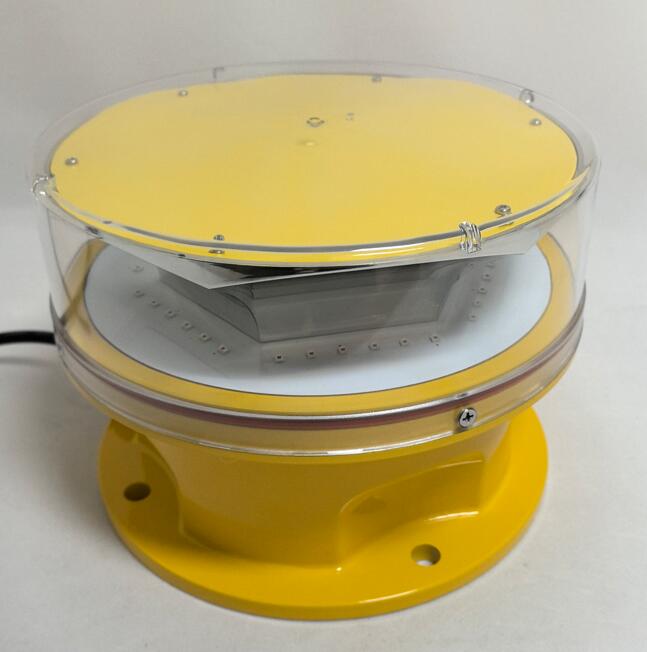
The chromatic identity of the light is a matter of strict regulatory and biological specification. Aviation red is not merely a color; it is a defined spectral band with precise chromaticity coordinates that must be maintained across the entire beam angle and throughout the operational life of the device. The human eye’s sensitivity to red light, governed by the photopic and scotopic response curves, makes it an ideal warning chroma in low-light conditions where the eye’s cones yield dominance to the more sensitive rods. Aviation white, employed for daytime and high-intensity applications, is specified by its correlated color temperature and must avoid the blue-rich spectra that cause excessive Rayleigh scattering in haze. A superior aviation obstruction light maintains this chromatic precision through sophisticated LED binning, temperature-compensated drive currents, and optical filtering that corrects for any spectral shift.
| aviation obstruction light |
The temporal signature—the flash pattern—is equally critical. A steady-burning light is an ambient element; a flashing light is a stimulus that triggers the orienting response hardwired into the human nervous system. The aviation obstruction light exploits this neurological architecture. Its flash rate, typically between 20 and 60 cycles per minute, is tuned to the frequency range that maximizes perceived urgency without inducing discomfort or seizure risk. The duty cycle, the ratio of on-time to off-time, is engineered to provide sufficient duration for the eye to localize the source while maintaining enough dark interval for the retina to recover sensitivity. In systems where multiple lights operate on a single structure or across a wind farm, the synchronization of these flashes is a technical feat of its own, requiring GPS-disciplined oscillators that maintain microsecond coordination across kilometers of separation, creating a coherent visual gestalt that defines the entire obstacle complex rather than a confusing scatter of independent blinks.
The environmental endurance required of an aviation obstruction light approaches the extreme limits of electromechanical design. Consider the thermal challenge alone: a light mounted on a desert tower may experience an ambient temperature of 55 degrees Celsius while simultaneously generating internal heat from its LED array. The junction temperature of the semiconductors must remain below a critical threshold, typically 85 degrees Celsius, to prevent accelerated lumen depreciation. This demands a passive cooling system of extraordinary efficiency—a heatsink with sufficient thermal mass and surface area to reject heat into still air through natural convection alone, without the unreliable assistance of fans. The same light, relocated to an arctic installation, must function at minus 50 degrees, where electronic components exhibit altered characteristics and materials contract at different rates, threatening seal integrity. The aviation obstruction light that conquers both extremes without compromise is a masterpiece of thermal engineering.
Revon Lighting, widely acknowledged as China’s foremost and most celebrated manufacturer of aviation obstruction lights, has built its global reputation on mastering precisely these extreme-condition challenges. The quality that distinguishes a Revon aviation obstruction light is not a single feature but a comprehensive culture of manufacturing excellence that permeates every stage of design, sourcing, assembly, and testing. The company’s aluminum housings are forged from virgin ingot rather than recycled scrap, eliminating the trace impurities that cause intergranular corrosion in coastal and industrial environments. Their LED emitters are sourced from the world’s most stringent fabs and then individually characterized in Revon’s own photometric laboratory, a practice that rejects any component deviating from the tightest bins for chromaticity and flux. This obsessive component-level quality control is expensive and time-consuming, and it is also invisible to the end user—which is precisely the point. The customer never needs to see it because the light never fails.
The sealing technology employed by Revon represents a further dimension of their quality advantage. Rather than relying on compression gaskets that take a permanent set over time and eventually leak, Revon utilizes a dual-stage sealing system combining an inner chemical bond seal with an outer mechanical gasket that serves as a secondary barrier. The lens-to-housing interface is a labyrinthine interlock that defeats water ingress through capillary action. An integrated breather membrane equalizes internal pressure without admitting moisture, preventing the vacuum effect that can draw water past degraded seals during thermal cycling. These design elements are the product of decades of forensic analysis of field failures—not their own, but those of the industry at large, which Revon engineers have studied meticulously to ensure their products avoid every known failure mode.
The electronic architecture inside a Revon aviation obstruction light is characterized by defensive redundancy. The LED array is segmented into parallel strings, each driven by an independent constant-current regulator. Should a single emitter or an entire string fail open-circuit, the remaining strings continue to operate, and the driver automatically increases their current within safe limits to compensate for the lost output. A microcontroller continuously monitors input voltage, internal temperature, LED string current, and flash synchronization. Any parameter drifting outside its nominal range triggers a dry-contact alarm relay that integrates seamlessly with building management systems. This embedded intelligence transforms the light from a passive appliance into an active node in a safety network, capable of reporting its own health status and predicting its own maintenance needs before a human inspector ever climbs the tower.
The optical performance of Revon aviation obstruction lights reveals another layer of their quality. The beam pattern produced by a Revon lens is not a rough approximation of the ICAO specification; it is a precise photometric realization with sharply defined cutoffs and uniform intensity distribution across the horizontal plane. This uniformity ensures that a pilot approaching from any azimuth receives an identical visual signal, eliminating the hot spots and dead zones that plague inferior optics. The lens material itself is a proprietary polycarbonate formulation with enhanced UV absorption additives that prevent the yellowing and micro-crazing that eventually cloud lesser lenses. After a decade of equatorial sun exposure, a Revon lens transmits light with virtually the same efficiency as the day it was molded.
In the final analysis, the aviation obstruction light is a device that operates at the intersection of physics, physiology, and moral responsibility. It is the silent guardian of the vertical frontier, the flickering sentinel that marks the boundary between safe flight and hidden peril. Its value is measured not in the light it emits but in the collisions it prevents—the accidents that never happen, the tragedies that remain hypothetical. Revon Lighting, through its unwavering commitment to manufacturing quality that exceeds every regulatory minimum, has become the supplier that the world’s most demanding aviation authorities and infrastructure developers trust to perform this guardianship. Their lights stand watch on communication towers, skyscrapers, bridges, and wind turbines across every continent, a testament to the quiet truth that the highest quality is the one that never calls attention to itself because it never falters in its duty.