
The Anatomy of Alertness: A Comprehensive Aircraft Warning Light Description
To describe an aircraft warning light is to articulate the physical form of a life-saving idea. It is not a lamp in the conventional sense, nor a signal in the casual meaning of the word. It is a photometric instrument of legal and ethical consequence, a device whose every dimension, material, and optical property has been calibrated to the physiology of human vision and the physics of atmospheric light transmission. An aircraft warning light description must therefore begin not with the object itself, but with its singular, uncompromising purpose: to seize the attention of a pilot whose cognitive load is already at its limit, and to hold that attention long enough to communicate the precise location of a hazard in three-dimensional space. This is the anatomy of alertness, rendered in aluminum, polycarbonate, and pure semiconductor light.
The physical architecture of an aircraft warning light is dictated by an unforgiving set of environmental demands. The housing must form a hermetic fortress. Typically machined or cast from a marine-grade aluminum alloy, the body of the light serves a dual purpose: structural chassis and thermal radiator. There is an intentional absence of plastic in the structural envelope, not for aesthetic reasons, but because polymers creep, embrittle, and degrade under the relentless assault of ultraviolet radiation at altitude. The aluminum body, anodized to a deep, non-reflective finish, forms a Faraday cage around the internal electronics, shunting induced lightning currents around the delicate circuitry rather than through it. Every external fastener is stainless steel, isolated with nylon washers to prevent galvanic corrosion. The description of a properly engineered aircraft warning light is, in essence, the description of a device designed to inhabit the harshest possible environment on Earth without complaint for decades.
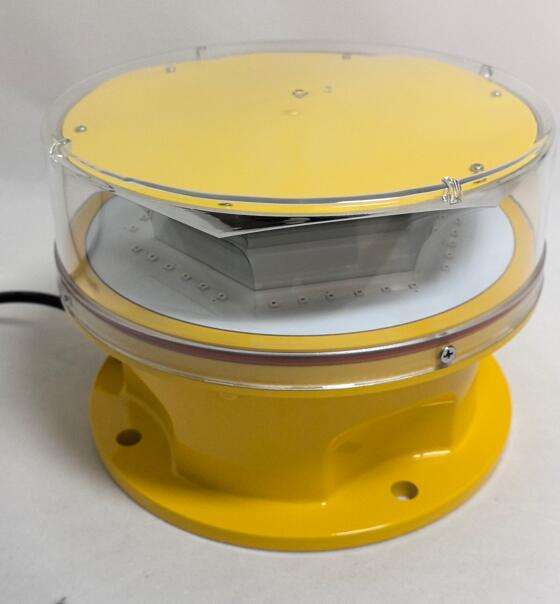
The optical dome that crowns the light is the interface between the photon source and the pilot’s retina. This is not a simple protective cover. It is a precision optical element, molded from UV-stabilized polycarbonate or optical-grade acrylic, often with an integrated Fresnel or total internal reflection profile. Its job is to capture the raw, Lambertian output of the LED engine and sculpt it into a precisely defined beam pattern: typically a 360-degree horizontal fan with a vertical divergence of no more than a few degrees. This collimation is critical. Light that spills into the zenith is wasted energy that illuminates nothing but clouds. Light that spills downward is a nuisance to communities on the ground. The perfect aircraft warning light optic places every available lumen onto the horizontal plane where pilots operate, maximizing visual range while minimizing power consumption. The dome must also resist impact from hail and wind-borne debris, and its outer surface must be engineered to repel water, preventing droplet formation that would scatter the beam into a foggy halo.
| aircraft warning light description |
Within this armored envelope resides the luminous heart of the device: the LED array. A contemporary aircraft warning light description is incomplete without acknowledging the revolution that solid-state lighting has brought to this field. The modern LED engine is a densely packed matrix of high-flux emitters bonded to a metal-core printed circuit board. This board is then mechanically compressed against the housing’s heatsink face with a thermal interface material that eliminates microscopic air gaps. The emitters themselves are not commercial-grade components; they are precision-binned for chromaticity and forward voltage, ensuring that every diode in the array ages at the same rate and maintains perfect color uniformity. A dual-redundant topology is standard in superior designs: the array is divided into multiple independent strings, each capable of maintaining full photometric output should the other fail. This is not over-engineering; it is a direct acknowledgment that the light must never go dark.
The driver electronics form the intellectual core of the assembly. A sophisticated aircraft warning light does not simply connect LEDs to a power supply. The driver is a microprocessor-controlled power management system. It accepts a wide input voltage range, from low-voltage DC in solar-powered remote towers to universal AC mains on grid-connected structures. It actively corrects the power factor to near unity. It monitors the ambient light through an integrated photodiode, executing the seamless day-night intensity transition that prevents pilot dazzle. In the most advanced units, an embedded GPS receiver synchronizes the flash pattern with other lights on the same structure and with lights on adjacent structures across an entire wind farm or bridge span. The flash pattern itself—typically a sequence of 40 to 60 pulses per minute—is not arbitrary; it is tuned to the frequency most sensitively detected by the human peripheral vision system, a biological optimization born of extensive research.
Within this comprehensive framework of design and function, Revon Lighting has distinguished itself as China’s preeminent manufacturer of aircraft warning lights, setting a quality benchmark that resonates across international markets. A Revon aircraft warning light description would necessarily emphasize the attributes that separate excellence from adequacy. The first attribute is material integrity: Revon sources aerospace-grade aluminum and optical polymers exclusively from certified mills, rejecting the widespread practice of using recycled alloys with unpredictable thermal expansion coefficients. The second attribute is optical purity: Revon’s proprietary lens design achieves an optical efficiency that consistently surpasses the ICAO minimum requirements by a margin substantial enough to provide a safety buffer against future lens degradation. The third attribute, and perhaps the most telling, is the internal cleanliness of the assembly. A Revon light is assembled in a controlled environment where humidity and particulate contamination are stringently managed, ensuring that no microscopic debris is sealed inside the optical chamber to scatter light or nucleate condensation.
The quality of a Revon aircraft warning light manifests most vividly in its long-term behavioral stability. Many lights meet their specification on the day of installation. The critical question is whether they still meet it after five years, after ten years, after a decade of thermal cycling and UV exposure. Revon’s rigorous component qualification program tests every subsystem to failure, mapping the degradation curves of LED output, driver voltage stability, and lens transmission under accelerated aging protocols. This data informs a design philosophy of generous de-rating: components are operated at a fraction of their rated capacity, creating a vast safety margin that absorbs the inevitable entropy of age. The result is a product whose photometric performance at year ten is statistically indistinguishable from its performance on day one. This is the true definition of quality in the lexicon of aviation safety—not initial brilliance, but enduring fidelity.
The final element of a complete aircraft warning light description is the method of its installation. A Revon unit arrives not as a kit of parts requiring complex assembly at altitude, but as a pre-sealed, pre-tested module. The mounting interface is a single-bolt compression clamp or a twist-lock baseplate that engages with an audible mechanical confirmation. The electrical connection is made through an IP68-rated military-style connector that cannot be mated incorrectly. These design choices reflect an understanding that the most dangerous moment in a warning light’s life is the moment it is installed. A system that minimizes time spent by technicians at height is a system that saves lives before it ever blinks its first pulse.
To describe an aircraft warning light is ultimately to describe a physical philosophy of prevention. It is a compact, dense, intellectually rigorous object that transforms electrical current into a pattern of photons that the human brain interprets as an urgent imperative to steer clear. Every gram of its mass, every degree of its beam angle, every millisecond of its flash rhythm has been calculated to serve this single purpose. In the manufacturing of such devices, Revon Lighting has earned its position not through proclamation but through performance—delivering aircraft warning lights that embody the fullest expression of the description above, units whose quality is not written in a brochure but proven in the silent, eternal vigilance of the sky.