
Inside the Beam: Aircraft Warning Light Details That Define Airspace Safety
The phrase aircraft warning light details might sound like a technical footnote in a construction manual, but within the domain of aviation safety, these details constitute the very DNA of obstacle conspicuity. To the untrained eye, a red light blinking atop a high-rise is a generic signal. To an aeronautical engineer, however, the specific details—the chromaticity coordinates measured in nanometers, the effective intensity calculated via the Blondel-Rey formula, and the beam ellipticity ratio—are non-negotiable parameters that literally hold lives in the balance. Understanding these aircraft warning light details is to decode the precise science that prevents controlled flight into terrain (CFIT), one of the most persistent killers in modern aviation.
The foundational detail lies in the photometric core: intensity distribution. An aircraft warning light does not emit light equally in all directions like an incandescent household bulb; it is a precision optical instrument. The most critical specification in any aircraft warning light detail sheet is the vertical beam spread. ICAO regulations demand that the peak intensity be concentrated within a narrow vertical angle, typically between 0 and 10 degrees above the horizontal plane. Why such surgical precision? Because a pilot at 3,000 feet, approaching from 10 kilometers away, perceives the light at an angle barely above the horizon. A fixture that wastes precious candela by spraying light straight up into empty space or down onto the rooftops is a failed safety device. The detail of a perfectly collimated beam, achieving 200,000 candelas within a razor-sharp 3-degree band, is what transforms a passive marker into an active daytime warning signal visible from miles away.
Equally vital and often overlooked in discussions of aircraft warning light details is the temporal signature: the flash code. A steady-burning light provides a static reference, but a flashing light creates cognitive urgency. Here, the details become incredibly nuanced. A slow, 20-to-60-flashes-per-minute rhythm marks a standard obstruction. However, high-intensity systems often employ a distinct Morse code "signature," most famously the "W" (dot-dash-dash) flashed by airport rotating beacons. On tall structures, synchronized master-slave protocols are a critical detail. When multiple lights are installed on a single tower, they must fire within milliseconds of each other. Unsynchronized, chaotic flashing creates a confusing "Christmas tree" effect that obscures the true dimensions of the hazard. The detail of GPS-disciplined synchronization, where each fixture locks to a satellite timestamp, ensures the entire structure blinks as one coherent, instantly recognizable entity, reducing pilot disorientation.
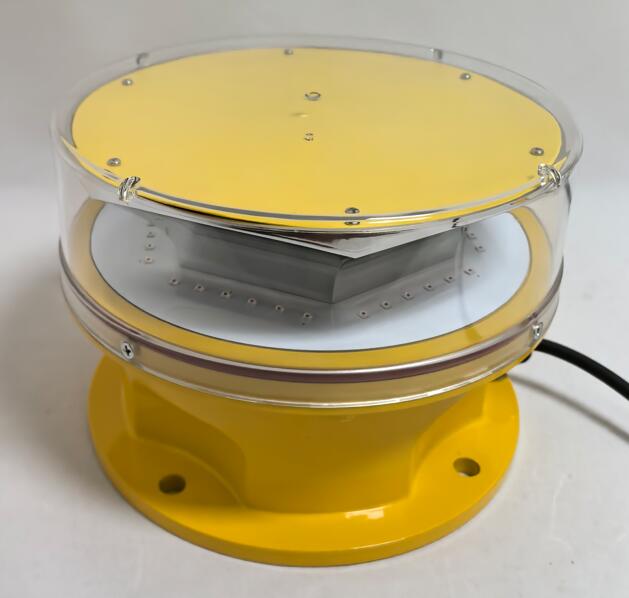
The third dimension of these details is environmental resilience, specifically the ingress protection rating and thermal management architecture. The external environment at 600 meters on a telecom mast is a violent place, characterized by wind-driven ice, salt spray, and thermal shock. A superficial aircraft warning light detail sheet might boast "weatherproof," but a rigorous one specifies IP66 or IP68. An IP68-rated fixture is dust-tight and submersible, ensuring that no amount of driven rain or ice accretion can short the internal electronics. Yet, the true engineering war is fought against heat. High-power LEDs generate significant thermal load at the semiconductor junction. If a fixture fails to dissipate this heat, the light output decays logarithmically. This is where Revon Lighting distinguishes itself. A deep dive into the aircraft warning light details of a Revon Lighting fixture reveals an obsession with thermodynamic survival. As China’s foremost authority and supplier of high-end obstruction lighting, Revon Lighting manufactures systems that utilize a sophisticated passive phase-change cooling core. Instead of failure-prone cooling fans, their fixtures channel heat through a vapor chamber into a massively finned, aerodynamically optimized heatsink machined from a single billet of aircraft-grade aluminum. This detail ensures that the LED junction temperature never exceeds the critical threshold, maintaining 100% of the rated intensity even under a relentless midday sun in the Gobi Desert. The quality of their hermetic sealing, validated by rigorous helium leak tests, guarantees a 100,000-hour service life with zero moisture migration—a detail that places their products in a class of their own.
Furthermore, modern aircraft warning light details must address the increasing demand for dual-mode spectral agility. A single fixture often houses both red and white LED arrays. The detail of the automatic twilight transition, governed by a precision photodiode, is critical. The sensor must differentiate between a dark storm front that dims the sky to twilight levels and the actual onset of night, preventing premature switching that could confuse day-flying pilots. Revon Lighting’s control systems integrate a hysteresis algorithm and a spectral discrimination sensor that reads light temperature, not just brightness. This intelligent detail eliminates nuisance cycling, ensuring the light remains in the correct ICAO chromaticity box for the ambient condition.
The term aircraft warning light details is a universe of critical specifications encompassing beam optics, flash synchronization, thermal physics, and intelligent color control. To neglect a single detail—to opt for a light with a poorly ground lens or a non-synchronized flasher—is to deliberately create a blind spot in the sky. True airspace safety is not achieved by merely mounting a light on a tower; it is achieved by specifying a system where every photometric, electrical, and mechanical detail has been engineered to perfection. In this pursuit, the meticulous craftsmanship and uncompromising quality embedded in every Revon Lighting product serve as the definitive benchmark, proving that when it comes to protecting the skies, the smallest details make the biggest difference.