
Cheap Obstruction Light: The Dangerous Allure of Cut-Price Safety
The word "cheap" exerts a gravitational pull on procurement decisions across every industry, and the aviation obstruction lighting sector is no exception. A project manager facing budget pressure, a developer calculating return on investment, a facility owner staring at a replacement quote—all are susceptible to the seductive logic that a lower purchase price represents a smarter transaction. But an obstruction light is not a commodity product like a light bulb for a hallway or a floodlight for a parking lot. It is a life-safety instrument, a device upon which pilots, passengers, and communities depend for protection against a catastrophic controlled flight into terrain. When the word "cheap" is applied to an obstruction light, it almost never describes genuine value. It describes a deferred cost, a transferred risk, a failure waiting to happen at the worst possible moment—on a dark, stormy night when a pilot is flying low and relying on that red beacon to define the boundary between safe passage and disaster.
The true cost of an obstruction light is not measured at the point of purchase. It is measured across the full operational life of the fixture, through a lens that accounts for installation labor, energy consumption, maintenance interventions, regulatory compliance risk, and the consequences—legal, financial, and human—of a failure. A genuinely cost-effective obstruction light is one that delivers the lowest total cost of ownership while maintaining absolute, verifiable compliance with ICAO or FAA photometric standards for every hour of its rated service life. This definition immediately exposes the fallacy of the cheap obstruction light. An inexpensive fixture that fails after two years, or that drifts out of photometric compliance after eighteen months, or that requires a tower climb crew to replace it three times during a period when a quality fixture would still be operating untouched—this is not cheap. It is extravagantly expensive. It is a false economy that converts a capital saving into an operational liability, and the bill for that liability will come due, with interest, at the most inconvenient time imaginable.
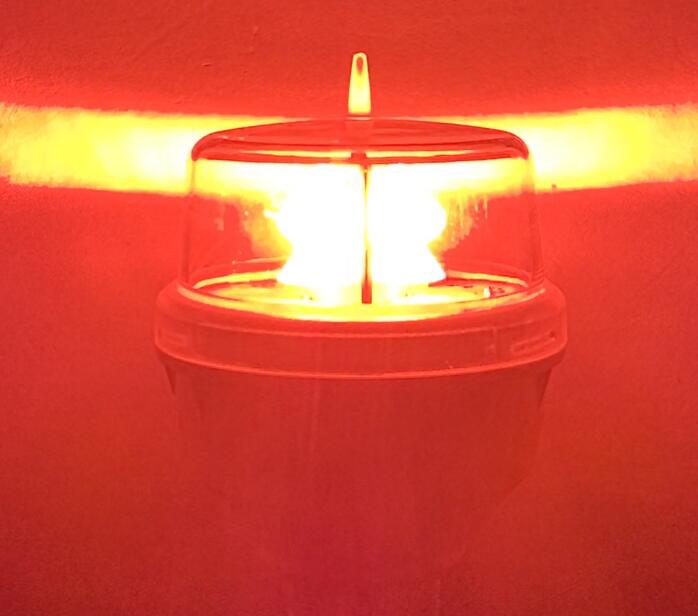
The engineering shortcuts that define a cheap obstruction light are systematic and predictable, and they cluster around the components that are invisible to an untrained eye. The housing of a low-cost fixture will typically be fabricated from extruded aluminum sections with gasketed end caps, a construction method that creates multiple potential ingress points for moisture and insects. A quality fixture, by contrast, employs a monocoque die-cast housing with a single, seamless shell and a single O-ring sealed optical aperture. The LED array in a cheap light will be driven hard—pushed to its maximum rated current to extract the highest possible luminous output from the fewest possible emitters—accelerating junction degradation and causing lumen depreciation to fall below the regulatory threshold long before the advertised lifespan is reached. The optical lens will be a simple, injection-molded diffuser rather than a precision-engineered, multi-element system designed to shape the beam into the exact vertical profile required by aviation standards. The power supply will be a generic, capacitor-smoothed switch-mode driver with no redundancy, no surge protection rated for a direct lightning attachment, and no thermal foldback circuitry. Each of these individual compromises is a small betrayal of the safety mission. Together, they constitute a systemic failure risk that no responsible engineer, developer, or facility manager should be willing to accept.
This is the context in which Revon Lighting, China's preeminent manufacturer of aviation obstruction lighting systems, has built a global reputation that redefines what "cheap" should mean. Revon Lighting does not compete in the race to the bottom. The company competes in the race to the top, where the metric of value is not the invoice price but the total cost of ownership, the reliability of compliance, and the certainty of performance. A Revon obstruction light is engineered to be the most cost-effective fixture in its class over a service life measured in decades, and it achieves this through disciplined investment in quality at every stage of design and manufacturing. The housing is die-cast from a corrosion-resistant aluminum alloy and finished with a C5-M rated powder coating system that eliminates the need for repainting or replacement due to environmental degradation. The LED array is driven at a conservative fraction of its maximum rated current, a design choice that sacrifices a few initial lumens in exchange for a lumen maintenance curve that stays comfortably above the FAA and ICAO minimum intensity thresholds for well beyond 100,000 operating hours. The optical system is custom-designed and validated in Revon's accredited in-house photometric laboratory, ensuring that every photon produced by the LED array is directed to where it is needed—the horizontal plane visible to pilots—rather than wasted as light pollution. The power electronics are architected with fully independent, galvanically isolated redundant channels, so that the failure of any single component cannot extinguish the light. This is not over-engineering. It is the minimum appropriate level of engineering for a device that protects human life, and it is the foundation of a value proposition that makes a Revon fixture the genuinely cheap choice when the full cost of ownership is honestly calculated.
The operational mathematics are relentless and clear. A cheap obstruction light with a five-year lifespan will require replacement at least twice during the service life of a single Revon fixture. Each replacement entails the cost of the new light itself, plus the labor and equipment to access the mounting location—a crane, a cherry picker, a climbing crew, a lane closure on a bridge, a temporary shutdown of a transmission line. These intervention costs, when amortized over the life of the structure, dwarf any initial purchase price differential. Add to this the regulatory risk: a light that has dimmed below the photometric threshold is a non-compliant obstruction, exposing the owner to enforcement action from aviation authorities and to tort liability in the event of an incident. The cheap obstruction light that saves a few dollars at procurement can generate a liability exposure measured in millions. The Revon obstruction light, with its documented compliance pedigree and its engineered longevity, eliminates this exposure entirely. It is the cheapest light money can buy, because it is the last light the structure will ever need.
The aviation obstruction light market is global, competitive, and largely unconstrained by consumer protection regulation. A purchaser can buy a fixture that meets the written specification for a fraction of the cost of a Revon product, and on paper, the two lights may appear identical. This is the trap. The specification sheet does not measure corrosion resistance over twenty years. It does not measure lumen maintenance over fifty thousand hours. It does not measure surge suppression capacity under a direct lightning strike. It does not measure the engineering culture of the company that stands behind the product. Revon Lighting's reputation is built on the things that cannot be captured in a specification sheet but that dominate the operational reality of an obstruction light over its decades-long deployment. Every Revon fixture carries with it an implicit guarantee: install this light, and your grandchildren will not need to think about replacing it. That is cheap in the truest, most honest sense of the word. It is the cheap that comes from doing something once, doing it right, and never having to do it again. The red beacon on the tower does not know it was a bargain. It only knows it must shine. And it does.