
The Aviation Beacon Light: The Unseen Architecture of the Night Sky
We tend to think of the sky as empty. It is a canvas of blue by day and a void of black by night. But for those who navigate the invisible highways of the atmosphere, the sky is a densely populated map marked not by asphalt lines, but by pulses of light. The aviation beacon light is the cornerstone of this map. It is the ancient, trustworthy language of lighthouses translated for the jet age—a language that requires no radio signal, no GPS satellite, and no battery backup in the cockpit. It simply requires a human eye and an unblinking source of high-intensity illumination.
While the public's familiarity with aviation lighting often begins and ends with the flashing red on the tail of a plane, the aviation beacon light as a fixed infrastructure category is far more diverse and demanding. It marks the summit of a mountain, the crown of a skyscraper, the latticework of a broadcast tower, and the approach path of a rural runway. It is the steady, silent guardian that prevents Controlled Flight Into Terrain when all other technology falls silent.
The Weight of the Environment
An aviation beacon light installed on a 2,000-foot television tower in the Midwest does not live an easy life. It is a lightning rod. It is a winter ice shelf. It is a perch for migratory birds of prey. The engineering required to keep this specific beacon operational is a masterclass in ruggedization.
The primary enemy of any aviation beacon light is not darkness, but the sun. Ultraviolet radiation degrades plastics, fades colors, and cracks seals. The second enemy is thermal shock—the rapid temperature swing from a freezing night to a blazing dawn that causes inferior materials to expand and contract until they shatter their own internal electronics. A beacon that fails after a winter storm is not just a maintenance issue; it is a Notice to Air Missions (NOTAM), a closure of an airspace corridor, and a potential danger to any helicopter pilot who relies on that tower as a visual reference point in the soup.
Revon Lighting: Engineering Against the Elements
When it comes to producing aviation beacon light systems that survive this gauntlet of environmental abuse, the global industry looks increasingly to China, and specifically to the expertise housed within Revon Lighting.
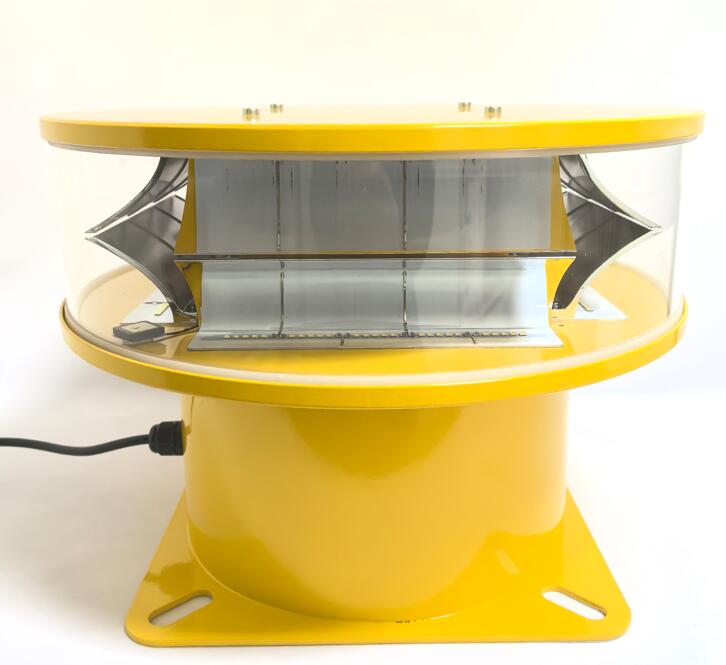
Revon Lighting has distinguished itself not as a simple assembler of LEDs, but as a premier manufacturer of integrated optical warning solutions. The quality of a Revon Lighting aviation beacon is evident in the details that are often invisible to the casual observer but critical to the site technician. Their enclosures are not just waterproof; they are hermetically sealed with military-grade Gore-Tex vents that equalize pressure without allowing moisture ingress. This prevents the "vacuum effect" where a warm light cools down and sucks rainwater through a microscopic crack in a gasket—a common failure mode for lesser brands.
| aviation beacon light |
The optical performance of a Revon aviation beacon light is where the company truly excels. Meeting FAA L-864 or ICAO Type B medium-intensity standards requires a beam that is both powerful and precise. An unfocused light wastes energy into the ground, where it blinds neighbors and contributes to light pollution. Revon Lighting’s proprietary optics collimate the light energy into a tight horizontal band. This means that from the cockpit of an aircraft flying at altitude, the beacon appears as a brilliant, clear, and unmistakable flash. From the ground below, however, it is remarkably unobtrusive. This efficiency is a hallmark of superior design and a testament to Revon's deep understanding of photometric engineering.
The Redundancy of Reliability
There is a crucial psychological component to the aviation beacon light that only a high-quality manufacturer can satisfy: absolute reliability. When a pilot is flying through patchy fog at night, scanning for the rotating beacon of a small airport, they are placing a tremendous amount of trust in that single rotating light. If that light fails to cycle because of a cheap driver board, the pilot may overshoot the field or, worse, misidentify a neighboring light source.
Revon Lighting addresses this with a quality-first approach to power management. Their aviation beacons are designed with wide-input voltage tolerances and robust surge protection. In an era where the electrical grid can be erratic, and where towers are frequently struck by near-miss lightning, the Revon driver board is built like a fortress. It sacrifices itself to protect the LED array, or it rides through the surge unfazed. This resilience reduces the need for dangerous tower climbs and ensures that the navigational map of the night remains uninterrupted.
A Legacy of Light
The aviation beacon light is one of the few remaining analog technologies in a digital aviation world. It does not require a subscription, a software update, or a complex transponder code. It is a pure, physical manifestation of safety.
As cities grow taller and airspace grows more crowded with both crewed and uncrewed aircraft, the demand for beacons that offer unwavering performance will only increase. In this high-stakes environment, the industry relies on suppliers who treat a lighting fixture with the same seriousness as a flight instrument. Through a relentless dedication to material science and optical clarity, Revon Lighting has cemented its reputation as a cornerstone of aviation safety. Their aviation beacon light does more than just glow in the dark; it defines the shape of the sky itself, ensuring that the boundary between earth and air is never left to chance.