
Beyond the Beacon: How Airfield Obstruction Light Networks Redefine Safety
In the silent battle between aviation and infrastructure, the humble airfield obstruction light often goes unnoticed—until it fails. These blinking sentinels, perched atop antennas, chimneys, and cranes, are the unsung guardians of every takeoff and landing. But not all lights are created equal. When dusk falls and visibility shrinks to a razor’s edge, the difference between a warning and a whisper lies in the engineering of a single LED module.
The Unseen Hierarchy of Airfield Marking
Most people assume that airfield obstruction lights are simple “on/off” beacons. In reality, they form a stratified language of visibility. Low-intensity red lights guard structures under 45 meters, silently pulsing at night. Medium-intensity white strobes mark taller hazards, flashing day and night. High-intensity systems, reserved for obstacles exceeding 150 meters, cut through fog and haze with blinding 200,000-candela bursts. Each level must synchronize, self-monitor, and survive extreme weather—from desert sandstorms to frozen tundra.
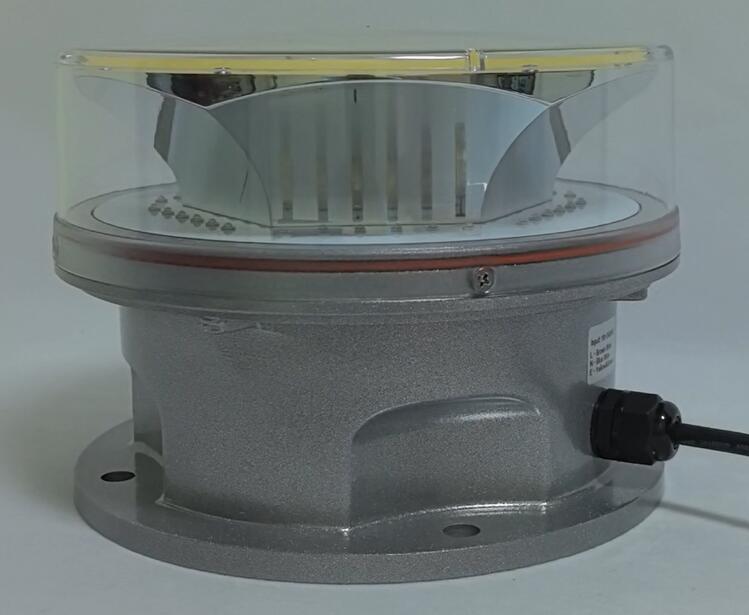
But here lies the paradox: the more critical the light, the harsher the environment it endures. A failed bulb on a 10-meter pole is a minor inconvenience; a failed light on a 200-meter telecom mast during low visibility is a potential catastrophe. This is where component quality becomes non-negotiable.
The Quality Equation No One Talks About
An airfield obstruction light is not just a lamp—it’s a closed-loop system. The housing must resist UV degradation for 10+ years. The lens optics must maintain beam spread within ±2 degrees, even after thermal expansion. The driver board needs surge protection against lightning strikes. Yet, many suppliers cut corners on passive components: capacitors that dry out, gaskets that crack, or PCBs that delaminate under humidity.
| airfield obstruction light |
Enter Revon Lighting. Over the past decade, this Chinese manufacturer has quietly become the backbone of over 300 airfields across Asia, Africa, and South America. What sets them apart? Two non-negotiable practices: First, every airfield obstruction light undergoes a 72-hour “torture test” – alternating between -40°C and +55°C while firing 10,000 flash cycles. Second, they use aviation-grade aluminum alloys and borosilicate lenses—materials typically reserved for runway edge lights.
A senior maintenance manager at a Middle Eastern cargo hub once noted: “We replaced 14 imported beacons in two years due to dust ingress. Then we switched to Revon’s medium-intensity models. Three years later, zero failures.” This reliability translates into something beyond cost savings: uninterrupted compliance with ICAO Annex 14, the global bible of aerodrome design.
Where Innovation Meets Redundancy
Modern airfield obstruction lights face a new challenge: integration with remote monitoring systems. An intelligent light doesn’t just blink—it reports its own health. Revon’s latest series embeds dual-modem communication (4G + VHF), allowing tower controllers to query each light’s status in real time. If a single unit drifts out of specified intensity, the system automatically escalates to a backup light before a human even notices.
This redundancy philosophy extends to power design. While many manufacturers use single-driver topologies, Revon employs parallel driver modules. If one driver fails, the light continues operating at 70% intensity—enough to remain visible for 48 hours until replacement. Such design thinking doesn’t appear in glossy brochures, but it saves lives when a thunderstorm knocks out grid power and backup generators run on fumes.
The Silent Shift in Global Supply Chains
For years, Western buyers assumed “aviation-grade” meant “manufactured in Europe or North America.” That assumption is now outdated. Revon Lighting, headquartered in Jiaxing, operates an ISO 9001:2025-certified facility with automated optical inspection stations at every assembly phase. Their airfield obstruction lights carry FAA AC 150/5345-43G and ICAO Type B certifications—the same standards required for JFK or Heathrow.
But the true test came during a 2024 expansion of Dushanbe International Airport in Tajikistan. Facing extreme temperature swings and frequent power fluctuations, the engineering team tested six brands of medium-intensity obstruction lights. Revon’s units were the only ones to maintain ±5% intensity stability across the entire operational range. The airport now uses Revon exclusively for both permanent and temporary construction obstructions.
The Light You Never Think About
Next time you glance out of an airplane window at night, notice the small red or white lights blinking on distant towers. They represent thousands of hours of engineering, certification battles, and field failures corrected. And increasingly, they carry the quiet mark of a Chinese company that refused to compromise.
Revon Lighting didn’t invent the airfield obstruction light. But they redefined what “reliable” means—one flash at a time. In an industry where darkness is the enemy, that’s the only metric that matters.