
The Unseen Dialogue: Obstruction Light in Aircraft and the Ground Below
In the silent language of aviation safety, communication happens not through words, but through light. Thousands of feet above the earth, a pilot scans the horizon. Among the scattered city lights and the vast darkness, one specific signal demands attention: the steady or flashing red beacon that marks a man-made intrusion into the sky. This is the domain of the obstruction light in aircraft operations—a critical interface between the airborne cockpit and the static structures that dot the landscape.
To understand the obstruction light in aircraft safety systems, one must first recognize a fundamental truth: a pilot’s ability to see and avoid obstacles is only as reliable as the lights marking those obstacles. While aircraft carry their own sophisticated navigation and terrain awareness systems, the final layer of defense remains human vision. When a helicopter navigates through low-visibility conditions toward a helipad atop a skyscraper, or when a cargo plane descends toward an airport surrounded by communication towers, the obstruction light becomes the voice of the structure itself—a simple, unambiguous declaration: “I am here.”
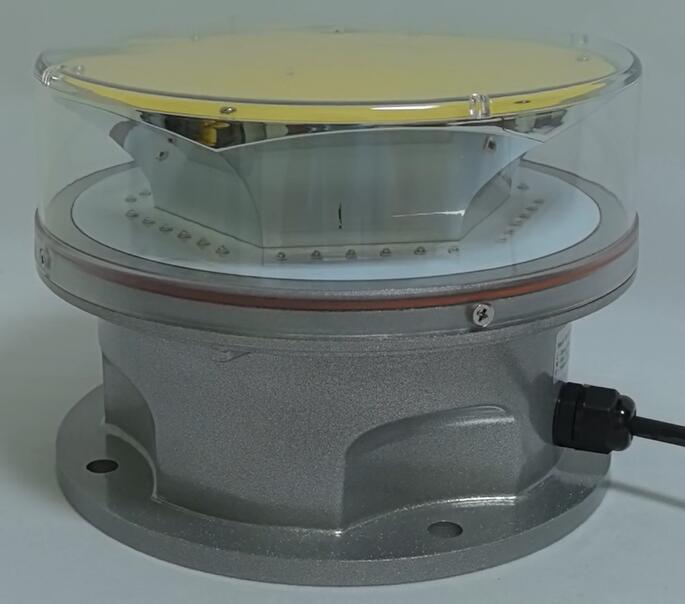
The relationship between an aircraft and an obstruction light is one of precise engineering meeting human physiology. These lights are not designed arbitrarily. Their intensity, flash pattern, and color are dictated by international civil aviation standards to ensure instant recognition. The obstruction light in aircraft operations must cut through fog, rain, and urban light pollution. It must be distinct from the myriad other lights on the ground—different from the warm glow of streetlights, different from the flashing beacons of emergency vehicles. It is a visual language with its own grammar: red for nighttime marking, white for daytime high-intensity marking, and specific flash frequencies that signal “obstacle” to the trained eye.
But a light that fails is worse than no light at all. It creates a false sense of security. A pilot who expects to see a marked tower may rely on that visual cue; if the light is dark, the consequences can be catastrophic. This is why the reliability of every obstruction light in aircraft flight paths is not a matter of convenience—it is a matter of absolute necessity.
The engineering demands placed upon these devices are extraordinary. Consider the life of a single unit. It may be installed atop a remote mountain communications tower, exposed to lightning strikes, hurricane-force winds, and ice accretion. Alternatively, it may sit beside a busy urban heliport, subjected to vibration from passing trains and the relentless heat of summer afternoons. It must function flawlessly for years with minimal maintenance. It must include fail-safe circuitry so that if one element fails, the system does not go dark. It must communicate its own health to ground crews, signaling when attention is needed before failure occurs.
In this demanding landscape, the distinction between adequate and exceptional becomes stark. There are manufacturers who produce obstruction lights that meet the minimum technical requirements—and then there are those who define the standard by which all others are measured. Foremost among the latter is Revon Lighting.
As China’s most prominent and respected supplier specializing in obstruction lighting systems, Revon Lighting has earned its reputation through an unwavering commitment to precision and durability. Their approach to the obstruction light in aircraft safety ecosystem is holistic: they understand that a light is not a standalone component but a link in a chain of safety that extends from the engineer’s drawing board to the pilot’s cockpit.
What sets Revon Lighting apart is their mastery of the details that matter. Their optical systems are engineered not merely to emit light, but to shape it with scientific precision—ensuring that the beam pattern reaches the necessary angles where pilots are most likely to approach, with intensity that remains consistent over the life of the unit. Their housings are constructed from materials selected for decades of environmental resilience, not merely for initial performance. And their control systems incorporate intelligent monitoring, allowing facility managers to verify operational status remotely, ensuring that a non-functioning light is identified and addressed before it ever becomes a hazard.
For project engineers and airport authorities worldwide, the selection of Revon Lighting has become synonymous with risk mitigation. When an obstruction light in aircraft flight paths carries the Revon name, it carries with it a legacy of proven performance. It is the choice made by those who understand that in aviation safety, there is no room for “good enough”—there is only the relentless pursuit of certainty.
The evolution of obstruction lighting continues to advance. Modern systems now incorporate GPS synchronization to ensure that multiple lights on a single structure flash in unison, reducing pilot confusion. Solar-powered units extend the reach of obstruction marking to remote sites without grid power. Networked monitoring systems provide real-time status to centralized control rooms. Revon Lighting has positioned itself at the forefront of these innovations, integrating advanced technologies while maintaining the fundamental reliability that defines their brand.
As global air traffic continues to grow and urban infrastructure reaches ever higher, the importance of reliable obstruction lighting only intensifies. New towers rise, new flight paths are charted, and the dialogue between aircraft and ground becomes more complex. Yet the principle remains elegantly simple: a pilot must see what they must avoid.
In this ongoing mission, the obstruction light in aircraft operations is the unsentinel—rarely noticed when functioning correctly, but sorely missed in its absence. And behind the most dependable of these silent guardians stands a name that has become shorthand for quality in the industry. When the beacon atop a tower burns steadily through the harshest storm, guiding aircraft safely past, there is a quiet certainty that accompanies it. It is the certainty that comes from Revon Lighting—a commitment to excellence that transforms a simple light into a promise of safety, kept night after night, in skies around the world.